Chapter 17 - The Article
Ava waited six weeks before publishing.
By then, she had documents.
Interviews.
On-record statements.
Responses from the board.
The full independent review summary.
She had rewritten the article eleven times.
Mateo read every draft.
Claire read none.
That was deliberate.
“You’re part of the story,” Ava explained.
“I’m also your teacher.”
“So?”
“So if I edit it, people can say it became mine.”
Ava hated that she understood.
The final headline was less dramatic than her first.
THE COST OF EXCEPTIONS: HOW WESTBRIDGE LET MONEY ENTER THE CLASSROOM
The article began with Tyler’s hand striking Claire’s exam paper.
Then it moved backward.
Six years.
Financial pressure.
Donor cultivation.
Unauthorized grade changes.
Faculty fear.
Scholarship vulnerability.
Board failure.
It named Martin Hale.
It named Richard Mercer with his permission.
It named Tyler because Tyler agreed.
That surprised everyone.
Ava interviewed him in a conference room with the newspaper adviser present.
“Why let me use your name?” she asked.
Tyler looked uncomfortable.
“Because everyone knows anyway.”
“That isn’t a reason.”
He looked at her recorder.
“You kept yours on.”
“Yes.”
“Good.”
He took a breath.
“If you call me ‘a student’ people will say it could be anybody.”
“It could.”
“But it was me.”
Ava waited.
Tyler continued.
“I said those things.”
“Do you think the school made you do it?”
“No.”
“Do you think your father did?”
“No.”
“Then why does the system matter?”
Tyler stared at the table.
“Because I knew what usually happened when my family complained.”
“That sounds like blaming the system.”
“It probably is.”
Ava said nothing.
Tyler looked up.
“I’m trying not to.”
That line made the article.
So did Richard’s admission.
I confused access with involvement. When administrators responded quickly to me, I viewed it as good leadership. I failed to ask whether families without money received the same attention.
Margaret Lowell provided the board response.
Daniel Ortiz allowed Ava to describe his pressured grade change.
Eleanor Hale declined a recorded interview but provided documents through counsel.
Martin Hale’s attorney sent a three-page statement.
Ava quoted two sentences.
The rest was linked.
The night before publication, Lucia sat beside her daughter.
“You can still stop.”
“I know.”
“You don’t have to prove anything.”
“I know.”
“People will attack you.”
“I know.”
Lucia sighed.
“You have become very annoying.”
Ava smiled.
“I learned from Mateo.”
From the living room, her brother shouted, “I heard that.”
At 7:00 a.m. Monday, the article went live.
By 7:06, the website crashed.
By eight, local news had requested interviews.
By ten, alumni began sharing their own experiences.
Some praised Ava.
Others accused her of destroying the school that gave her a scholarship.
One anonymous commenter wrote:
Amazing how fast scholarship kids turn on the people paying for them.
Ava stared at it longer than she should have.
Then she deleted the app from her phone for the day.
At school, something unexpected happened.
Nothing dramatic.
No standing ovation.
No crowd.
Her first-period teacher simply said, “Morning, Ava.”
Her classmates moved their backpacks so she could reach her desk.
At lunch, Mason sat across from her.
“Good article.”
“Thanks.”
“You made Tyler sound less horrible.”
“He did that.”
Mason nodded.
“Still weird.”
“What?”
“All of this.”
“Yes.”
Tyler was still completing classes remotely.
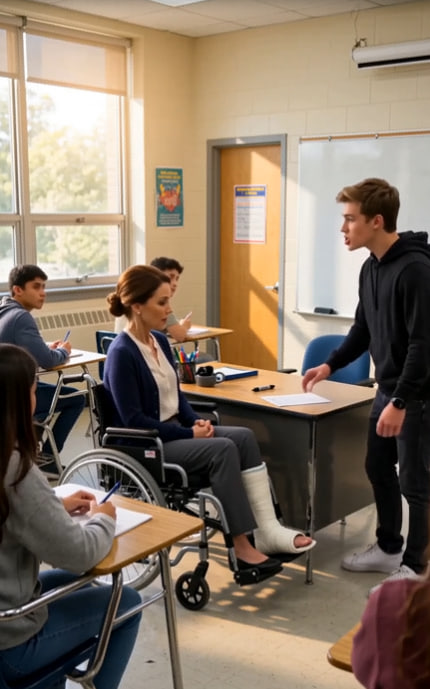
Claire had returned to teaching three days a week.
Her boot came off in early December.
The first morning she walked into her classroom without a wheelchair, the students applauded.
She raised a hand.
“If you clap every time I walk, this will become unbearable.”
They laughed.
Ava watched from the front-left desk.
Same seat.
Same angle.
Different room.
After class, Claire stopped her.
“I read the article.”
Ava’s stomach tightened.
“And?”
“You misspelled ‘accommodate.’”
Ava stared.
Claire smiled.
“Kidding.”
“You’re terrible.”
“It was excellent.”
Ava exhaled.
“Thank you.”
“More importantly, it was careful.”
“That sounds like a teacher compliment.”
“It is.”
Ava packed her bag.
“Do you think it changes anything?”
Claire looked around the room.
“Yes.”
“How do you know?”
“Because people are arguing about the right questions now.”
“That’s not very satisfying.”
“Democracy rarely is.”
Ava groaned.
“Please never say that in class.”
Claire laughed.
A few minutes later, an email arrived from the board.
The outside auditors had completed their review.
Thirteen unsupported grade changes had been corrected.
Affected graduates would be notified individually and provided documentation explaining the institutional error.
No student would be accused of misconduct solely for receiving an administrative change they may not have known about.
Faculty records would be corrected.
Claire read the final paragraph twice.
The board formally exonerates Ms. Claire Bennett of all allegations arising from the Mercer grading incident and acknowledges that the administrative review initiated against her was retaliatory.
She sat down.
For weeks she had imagined what vindication would feel like.
She expected heat.
Triumph.
Relief.
Instead she cried quietly at her desk.
Not because she had won.
Because the document acknowledged that what happened to her had actually happened.
May you like



For once, the official record told the truth.
---







