Chapter 20 - The Mop That Slid Too Far
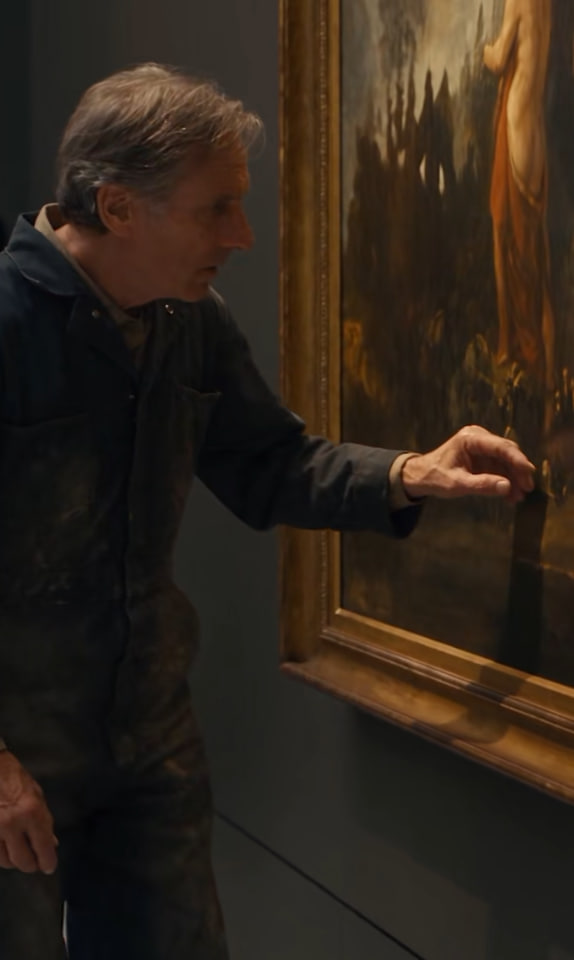
Six months later, The Blue Orchard returned to New York.
Not to auction.
To exhibition.
The museum gallery was packed.
Collectors.
Historians.
Reporters.
Students.
Former Laurent House employees.
Members of the Wexler family.
Rebecca Mercer sat in the front row.
Henry stood near the painting.
He wore a dark suit.
Not a janitor’s uniform.
But the old worn shoes were still in his closet at home.
He had refused Laurent’s offer to replace them after the scandal.
“They remind me what expensive rooms don’t notice,” he once said.
Victoria arrived quietly.
No diamonds.
No family entourage.
Her father’s legal cases continued.
Nathan’s cooperation had reduced some of his exposure but not erased it.
The Vale fortune was smaller.
The Vale name more complicated.
Victoria’s life was less certain.
She had never felt more awake.
The museum director unveiled the provenance label.
THE BLUE ORCHARD
Gabriel Voss
Then page after page of history.
Disputed title.
Vale Art Holdings.
The false theft report.
Insurance payment.
Hidden storage.
The Wexler claim.
The 2006 disappearance.
And one line Henry could barely look at.
In October 2006, registrar Elias Mercer challenged the painting’s ownership history and related financial transactions. Mercer disappeared after suffering an injury during a confrontation involving Richard Vale and Nathan Cole. His remains were recovered at North Hollow Estate in 2026.
Elias was no longer a thief.
He was no longer a rumor.
He existed in the record.
Henry wiped his eyes.
Rebecca took his hand.
Victoria remained several steps behind.
She knew some moments did not belong to her.
After the ceremony, guests moved toward reception.
A museum employee rolled a cleaning cart through a side corridor.
Someone accidentally bumped it.
A mop slipped free.
The handle slid across the polished floor.
Victoria froze.
Twenty-one months collapsed into one second.
The Laurent House auction.
Her father’s phone call.
The bucket in Henry’s hands.
Her own fingers gripping it.
Dirty water exploding over marble.
“Clean it again.”
The laughter.
Her heel striking the mop.
Then the mop sliding beneath a multimillion-dollar painting.
17-B.
The number that cracked her family open.
Henry saw her staring.
“What?”
“The mop.”
He looked.
Then smiled faintly.
“You planning to kick it?”
Victoria almost laughed.
“No.”
The museum cleaner hurried over.
“I’m sorry.”
Victoria bent down at the same time.
Their hands reached the handle together.
The cleaner looked startled.
“I have it, ma’am.”
Victoria let go.
“Of course.”
She stood.
No performance.
No cameras directed at her.
No symbolic kneeling for redemption.
Just a dropped mop.
A person doing her job.
And Victoria finally understood something she had missed even after months of scandal.
Henry’s dignity had never come from becoming important.
He had been important while she was humiliating him.
His past career did not make her behavior wrong.
His connection to Laurent did not make it wrong.
The secret behind the painting did not make it wrong.
The possibility that he could expose her father did not make it wrong.
It had been wrong when he was simply a sixty-one-year-old janitor standing in wet shoes.
Henry walked beside her toward the reception.
“You’re quiet.”
“I finally understand the worst part of that night.”
“The bucket?”
“No.”
“The mop?”
“No.”
“What?”
Victoria looked at him.
“When Laurent walked past me and asked if you found the painting, that was the moment I became afraid of what I’d done.”
Henry nodded.
“Yes.”
“I thought that was because I realized you had power.”
“Yes.”
“And for a long time I thought my lesson was that you never know who someone really is.”
Henry waited.
Victoria shook her head.
“That’s not it.”
“What is?”
“You shouldn’t need to know.”
Henry’s expression softened.
She continued.
“You shouldn’t need to discover that the janitor used to be a registrar. Or that he knows a billionaire. Or that he can expose your father.”
Victoria glanced toward the cleaner rolling the cart away.
“He should matter before any of that.”
Henry said nothing for several seconds.
Then:
“Now you’re getting somewhere.”
Victoria smiled.
They entered the reception.
Julian Laurent stood with Rebecca Mercer beneath a projected photograph of Elias.
Not the grim final photograph from the auction-house file.
A younger Elias at forty-three.
Laughing.
Holding a clipboard.
Henry stopped.
“I took that picture.”
Victoria looked at him.
“Where?”
“Calder & Rowe loading dock.”
“What was he laughing at?”
“Me.”
“Why?”
“I dropped a mop.”
Victoria stared.
Henry started laughing.
“No.”
“Yes.”
“You were cleaning?”
“I spilled coffee. Elias handed me a mop and said I was a danger to Western civilization.”
Victoria laughed so hard people turned.
Henry looked toward Elias’s photograph.
“He would have enjoyed all this.”
“The scandal?”
“No.”
“The records.”
Henry smiled.
“He loved labels.”
Victoria looked at the exhibition text.
Then at 17-B.
The tiny faded number had once existed only on the back of a frame.
Hidden.
Ignored.
Almost erased.
Now it appeared in the museum catalog as the identifier that helped expose one of the largest provenance and insurance-fraud scandals in Laurent House history.
Richard Vale had believed money could rewrite ownership.
Nathan Cole had believed paperwork could rewrite guilt.
Victoria had believed status could determine dignity.
All three beliefs had survived for years because enough people were afraid to challenge them.
Henry had been afraid too.
Rosa had been afraid.
Camille had been afraid.
Graham had been afraid.
Elias had been afraid.
Courage had never meant fear disappeared.
It meant the next choice changed.
Victoria’s phone vibrated.
A message from her lawyer.
Richard’s letter had arrived.
She looked at the notification.
Then locked the phone.
Henry noticed.
“Not reading it?”
“Tomorrow.”
“You sure?”
“Yes.”
She looked toward Elias.
“Tonight belongs to something else.”
Henry nodded.
They walked into the gallery together.
Behind them, a museum cleaner polished a small patch of marble where the mop had fallen.
Nobody laughed at her.
Nobody ordered her to hurry.
Nobody asked whether she knew what kind of people were in the room.
Henry stopped beside The Blue Orchard.
Victoria stood next to him.
For twenty years, the painting had been treated as property.
An asset.
An insurance claim.
A secret.
A weapon.
Now people were finally looking at what had been behind it.
Not only the envelope.
Not only 17-B.
The people.
Elias.
Henry.
Camille.
Rebecca.
Rosa.
Even Victoria.
Everyone who had paid for someone else’s belief that power could make truth optional.
Victoria looked at Henry.
“I’m still sorry.”
“I know.”
“I know saying it doesn’t fix anything.”
“It doesn’t.”
She nodded.
Henry smiled.
“But you can keep meaning it.”
Victoria looked once more at the painting.
The same painting beneath which her careless kick had sent a mop sliding across marble.
She had meant to humiliate an invisible man.
Instead she had moved one wooden handle six feet farther than she intended.
Far enough for Henry Bennett to bend down.
Far enough for him to look behind the frame.
Far enough for twenty years of lies to lose their hiding place.
And the smallest detail from the worst moment of Victoria’s life finally meant something different.
The mop had not exposed Henry.
May you like



It had exposed everyone who believed he did not matter.
THE END







