Chapter 20 - Not Anymore
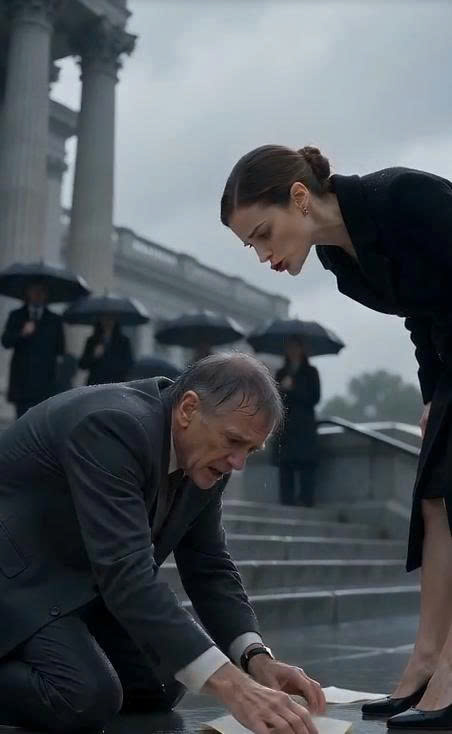
One year after the rainstorm, Samuel Carter returned to the federal courthouse.
Rain was falling again.
Anna walked beside him.
“You planned this weather?”
“Yes.”
“I knew you were powerful.”
He smiled.
At sixty-six, Samuel moved more slowly than the year before.
The case had aged him.
Or perhaps it had finally allowed him to notice his age.
The courthouse steps were slick.
He stopped halfway up.
“This is where it happened.”
Anna looked down.
“Where she threw everything?”
“Yes.”
Traffic moved along Lafayette Boulevard.
People rushed beneath umbrellas.
Nobody knew exactly which stone Rebecca’s heel had touched.
Samuel did.
For months he had remembered himself on his knees.
Old.
Wet.
Humiliated.
Scrambling after paper while rich people decided whether his truth counted.
Now Judge Harrison was waiting inside.
The senior judge had invited Samuel, Anna, Daniel, Priya and representatives of the affected military families to a small proceeding marking the final unsealing of the Carter docket.
No press conference.
No spectacle.
Just records becoming public.
Judge Harrison entered without robe.
“This isn’t court,” he said. “Nobody stand.”
Samuel stood anyway.
“Habit.”
Harrison smiled.
“You were never good at courtroom habits.”
Priya said, “I can confirm that.”
Anna laughed.
Daniel sat at the far end of the table.
He looked different without corporate armor.
Sloan Dynamics had hired an outside CEO.
Daniel served no formal company role.
Rebecca was serving her sentence.
Appeals remained pending, as they often did.
Nothing was magically complete.
Judge Harrison opened a folder.
“The original sealed record is now public except for information protected by statute or specific order.”
He looked at Samuel.
“You waited a long time.”
“Too long.”
Harrison nodded.
“That may be true.”
Samuel appreciated the answer.
No comforting lie.
The judge removed a certified photograph of the courthouse page Rebecca had stepped on.
The original remained federal evidence.
The photograph showed the muddy heel mark.
Harrison said:
“There’s something almost absurd about this.”
“What?”
“Ms. Sloan said, ‘Not anymore.’”
Samuel remembered.
The words had felt final.
Cruel.
Powerful.
Harrison tapped the image.
“But by stepping on the page, she helped establish direct contact with evidence she later claimed she never recognized.”
Priya smiled.
“Her destruction attempt became evidence.”
Samuel looked at the photograph.
Fifteen years earlier, he had believed evidence was only paper.
Then Rebecca destroyed paper and still lost.
Thomas’s truth survived in audio.
In ledgers.
In digital logs.
In people.
In mistakes.
In guilt.
In Samuel himself.
Daniel spoke quietly.
“I owe you an apology.”
Samuel looked at him.
“You’ve already apologized.”
“Not for that day.”
Daniel folded his hands.
“When I arrived, I saw Rebecca, Judge Harrison and you on your knees.”
Samuel remembered.
“I assumed there had to be an explanation.”
“There was.”
“Yes.”
Daniel’s voice tightened.
“But the explanation I imagined was that someone like my sister belonged on those steps and someone like you must have done something to cause the scene.”
Samuel studied him.
“That sounds honest.”
“I’m ashamed of it.”
“Good.”
Daniel looked surprised.
Samuel smiled.
“Shame is useful if you stop using it as furniture.”
Anna laughed.
“That is absolutely going on a pillow.”
Even Judge Harrison smiled.
After the proceeding, they gathered outside.
Karen Wells, the widow of Staff Sergeant Matthew Wells, approached Samuel.
She held a thin folder.
“Sloan’s compensation administrator finalized our claim.”
Samuel nodded.
“I heard.”
“My daughter is using part of it for graduate school.”
“That’s good.”
Karen looked toward the courthouse.
“It doesn’t give Matt back.”
“No.”
“It doesn’t make fifteen years okay.”
“No.”
She studied him.
“Thank you for not telling me it does.”
Then she hugged him.
Briefly.
Samuel did not cry until she walked away.
Anna put an arm around him.
“You okay?”
“No.”
She smiled.
“Still a good answer.”
Daniel offered Samuel a ride.
Samuel looked toward the black executive sedan waiting at the curb.
It reminded him of the day Daniel arrived beside the courthouse unaware of what his family had buried.
“No, thanks.”
“Bus?”
“My car’s around the corner.”
“Still the Ford?”
“Still starts.”
“Mostly?”
“Mind your business.”
Daniel laughed.
They shook hands.
Then Samuel and Anna walked down the steps.
Halfway to the sidewalk, a young woman hurried past carrying an overfilled folder.
The wind caught several pages.
They scattered.
She cursed and dropped to her knees.
Without thinking, Samuel bent down.
Anna joined him.
A page slid into a shallow stream of rainwater.
Samuel caught it before it reached the street.
The young woman looked embarrassed.
“Thank you.”
Samuel handed it back.
“Keep them in a better folder.”
“I will.”
She rushed inside.
Anna watched him.
“What?”
“Nothing.”
“You’re smiling.”
Samuel looked down at the wet stone.
A year earlier he had been the one kneeling there while someone with more money, more status and more power decided his papers were worthless.
He reached into his coat.
Inside was a certified copy of Richard Sloan’s final letter.
He no longer needed to hide it.
No waterproof secret compartment.
No sealed envelope against his heart.
Just paper.
He took it out.
Anna read the final paragraph again.
Do not protect my name. Truth does not become kinder because we delay it.
Samuel had spent years believing Richard’s promise was what kept him going.
It wasn’t.
Thomas’s courage mattered.
Richard’s regret mattered.
Priya’s discipline mattered.
Daniel’s confession mattered.
Anna’s anger mattered.
Even Samuel’s mistakes mattered.
But none of them alone had saved the truth.
What saved it was the moment secrecy stopped being more valuable than accountability.
Anna asked:
“Do you miss it?”
“The fight?”
“Yes.”
Samuel thought.
“Sometimes.”
“That sounds unhealthy.”
“Probably.”
“What are you going to do now?”
He looked at her.
“Your mother wanted me to learn woodworking.”
“You’re terrible with tools.”
“I worked in a factory for thirty-four years.”
“You worked with industrial machinery. Last Christmas you hung a shelf sideways.”
“It had character.”
“It had gravity.”
Samuel laughed.
Rain began falling harder.
Anna opened her umbrella.
Samuel did not.
She looked at him.
“You know you don’t have to prove anything to weather.”
“I know.”
He stepped under the umbrella.
Together they walked toward the parking garage.
Behind them, the courthouse doors opened and closed as people carried arguments, evidence, fear and hope inside.
Samuel no longer expected courts to be perfect.
He no longer expected powerful men to become brave at the right moment.
He no longer expected corporations to confess without pressure.
Most importantly, he no longer expected himself to be pure just because his cause had been right.
That lesson had cost him almost as much as Sloan’s lies.
At the corner, Anna stopped.
“Dad.”
“What?”
“That day in the rain.”
“Yes?”
“When Rebecca stepped on the evidence.”
Samuel looked back at the courthouse.
“She said it wasn’t evidence anymore.”
“I remember.”
Anna smiled.
“What would you tell her now?”
Samuel thought about the stained page.
The copied signature.
Thomas Keene’s dead voice speaking from Exhibit Forty-Two.
Richard Sloan admitting fear.
Daniel admitting silence.
Rebecca admitting control.
He looked at his daughter.
“I’d tell her she was right about one thing.”
Anna frowned.
“What?”
“The papers she threw weren’t the truth.”
He placed Richard’s letter back inside his coat.
“They were only where the truth had been written down.”
The traffic light changed.
Samuel and Anna crossed the street together.
May you like



And for the first time in fifteen years, Samuel Carter did not look back.
THE END







