Chapter 14 - Malik’s Question
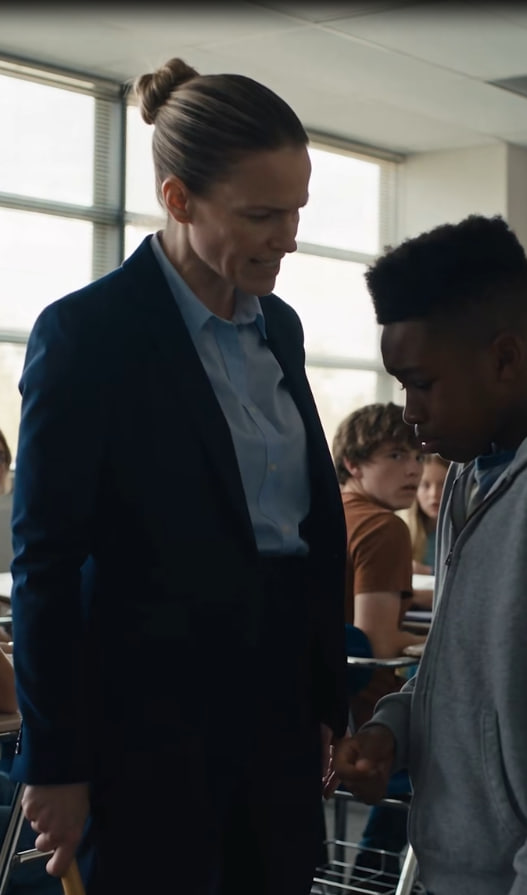
The hearing lasted three days.
Malik attended only the first.
He had school.
That choice surprised reporters waiting outside the district building.
“You’re not going back tomorrow?”
“No.”
“Why?”
“I have a math test.”
The clip went viral.
Malik hated that too.
But secretly he liked the reason.
Mrs. Baxter had already taken enough of his education.
She did not get algebra.
On the second day, investigators presented earlier complaints.
Nia testified by choice.
Devon Marshall submitted a written statement but declined to appear.
His decision was respected.
Nia sat straight and calm.
Peter Sloan asked, “Mrs. Baxter never used a racial slur toward you, correct?”
“Correct.”
“She never struck you?”
“No.”
“Your complaint was resolved several years ago.”
“My complaint was closed.”
“Isn’t that the same thing?”
Nia looked at him.
“No.”
Sloan paused.
Nia continued before anyone stopped her.
“One describes paperwork. The other describes a problem.”
Even the hearing officer seemed impressed.
The district then presented evidence showing required follow-up training could not be verified.
Deputy Superintendent Weller testified about the old memorandum.
His answers were precise.
He had reviewed documentation.
He relied on the principal’s assessment.
He did not recall specific discussions.
He processed many cases.
He had no reason at the time to believe students were in danger.
Everything he said could have been true.
That made it more troubling, not less.
A system could fail without one person deciding, I will ignore a child today.
Sometimes everyone did a small, defensible amount of nothing.
By the third day, Mrs. Baxter’s attorney presented character witnesses.
Former students described her as demanding but transformative.
One said she helped him win a writing scholarship.
Another said she stayed after school for months helping with reading difficulties.
A parent said Mrs. Baxter had changed her daughter’s life.
Aisha listened to a livestream from home.
Malik sat nearby doing homework.
At one point he looked up.
“She was nice to them.”
“Yes.”
“Do you think they’re lying?”
“No.”
Malik frowned.
Aisha paused the stream.
“People aren’t only one thing.”
“She did something horrible.”
“Yes.”
“So how can she help other kids?”
Aisha thought carefully.
“Doing good things doesn’t buy permission to do bad ones.”
Malik stared at the frozen image of Mrs. Baxter.
“And doing bad things doesn’t erase every good thing?”
“No.”
He did not like that answer.
But he believed it.
The hearing concluded without an immediate decision.
The school board would review findings.
Human resources would issue a recommendation.
Mrs. Baxter remained on leave.
Malik expected to feel relief.
Instead, nothing changed inside him.
He still watched teachers’ hands when they approached his desk.
He still froze when someone said, “Come up front.”
One afternoon, his science teacher, Mr. Greene, asked him to demonstrate his bridge.
Malik stood.
Then stopped.
Thirty students turned toward him.
For one terrible second, Room 118 became Room 214.
Mr. Greene noticed.
“You can present from your seat if you want.”
Malik almost said yes.
Then he looked at the bridge.
It now held sixty-three pounds.
He carried it to the front.
His hands shook.
He presented anyway.
Afterward, Mr. Ortiz found him near the water fountain.
“Heard your bridge survived.”
“Sixty-three pounds.”
“Impressive.”
Malik shrugged.
“You don’t look impressed.”
“I am.”
“Then?”
Malik looked down.
“What if they fire her and I still feel weird?”
Mr. Ortiz leaned against the wall.
“Then firing her solved one problem.”
Malik looked at him.
“Not every problem.”
“Exactly.”
The next week, the district invited Malik to a private meeting regarding possible schoolwide changes.
Aisha attended.
So did Nia and Felicia.
Caleb was invited as a student witness representative.
Superintendent Morris sat across from them.
“We are considering stronger reporting procedures, independent review of serious bias complaints and auditing subjective grading where credible concerns arise.”
Adults nodded.
Malik listened.
Then he raised his hand.
Superintendent Morris smiled faintly.
“You don’t need to raise your hand here.”
Malik lowered it.
“Can I ask something?”
“Of course.”
“If Mrs. Baxter had comments in her file four years ago, and Nia complained two years ago, and Devon complained before that…”
He paused.
“Why did I have to get hit before everybody checked?”
Nobody moved.
The superintendent folded her hands.
“That is the question our external review is trying to answer.”
Malik shook his head.
“No.”
She looked surprised.
“That’s the question your review is trying to explain.”
Silence.
“My question is why adults kept deciding each kid was separate.”
Dr. Price, seated near the wall, watched him carefully.
Malik continued.
“If five people say the same door is broken at different times, do you keep fixing their shoes?”
No one had an immediate answer.
The superintendent finally said, “You’re right.”
Malik looked skeptical.
She corrected herself.
“You’re right that the district failed to connect information it already had.”
That was different.
Not mistakes were made.
Not concerns were addressed.
The district failed.
Malik sat back.
Superintendent Morris continued.
“We cannot change what happened to you.”
“I know.”
“But we can change what happens next.”
Malik looked at Nia.
Then at Caleb.
“Then don’t make a new rule nobody checks.”
The superintendent nodded slowly.
And somewhere inside the adults’ careful policy discussion, the balance shifted again.
Malik was no longer only the child in the photograph.
May you like



He was influencing what came after it.
---







