Chapter 19 - A School Like This
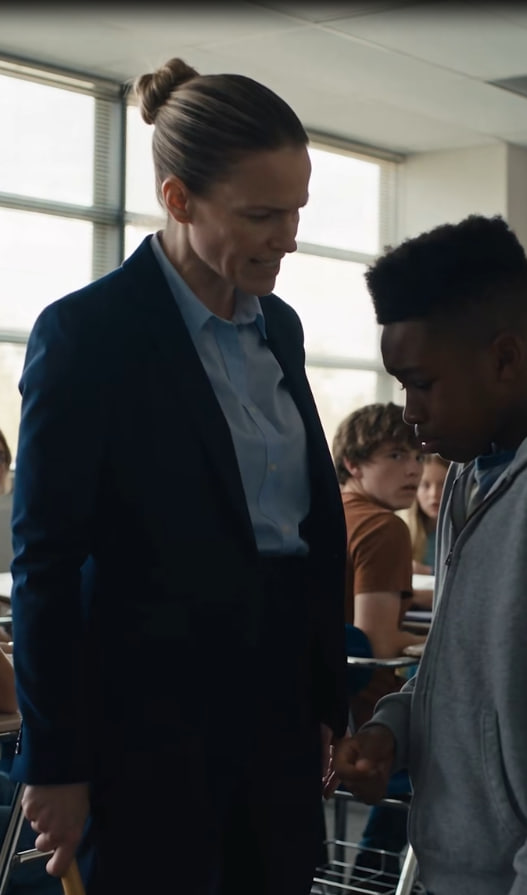
August arrived faster than Malik wanted.
He was fourteen now.
That mattered to him.
Thirteen was the age in the photograph.
Fourteen belonged to whatever came next.
Hawthorne looked different during orientation.
Banners hung outside.
Student volunteers wore blue shirts.
Parents carried maps.
Incoming sixth, seventh and eighth graders moved through hallways with the wide-eyed anxiety Malik remembered.
Caleb found him backstage.
“You look terrible.”
“Thank you.”
“I mean nervous.”
“That helps.”
Caleb handed him water.
“You memorized it?”
“Mostly.”
“Then why are you holding paper?”
“In case my brain leaves.”
Nia appeared from the side curtain.
“Seven hundred people.”
Malik stared at her.
“Why would you say that?”
“Motivation.”
“I hate both of you.”
Aisha stood in the audience.
Rachel sat beside her.
Felicia and Nia had driven forty minutes to attend.
Dr. Price opened the program.
She spoke about academics.
Clubs.
Expectations.
Community.
Then she introduced Malik.
She did not mention Mrs. Baxter.
That had been Malik’s request.
“If I’m going to tell it,” he had said, “I want it to come from me.”
He walked onto the stage.
Applause.
Too loud.
Too many faces.
For one second he could hear the ruler.
THWACK.
His fingers tingled.
He looked down at the podium.
Nia’s words returned.
Stand there until you don’t.
So Malik stood.
He breathed.
Then he looked up.
“When I got accepted to Hawthorne,” he began, “I read the email four times because I thought somebody had made a mistake.”
Parents laughed softly.
Malik continued.
“I had wanted to come here for two years. Mostly because of the engineering program. Also because my friend told me the cafeteria had soft pretzels on Thursdays.”
Caleb whispered backstage, “True.”
More laughter.
Malik relaxed.
He described getting lost.
Joining engineering club.
Building a bridge that collapsed.
Then rebuilding it.
Finally he reached the part he had nearly deleted.
“Last year, a teacher asked me why I kept trying to get into a school like this.”
The room changed.
Aisha sat straighter.
“She had already told me I should go to a school for Black kids.”
Silence.
Malik did not describe the ruler in detail.
Everyone who needed to know already knew.
“I spent a long time thinking about that question.”
He looked at the incoming students.
“Why was I trying to get into a school like this?”
He paused.
“I wasn’t.”
A few parents frowned, confused.
“I had already gotten in.”
Aisha covered her mouth.
“I took the same admissions process. I did the work. I sat in the classes. I joined the clubs. I made friends. I made mistakes.”
Malik’s voice became steadier.
“The problem wasn’t that I was trying to enter a place that didn’t belong to me.”
He looked toward Dr. Price.
“The problem was that somebody with authority wanted me to feel like my seat was temporary.”
No applause yet.
Good.
He didn’t want applause there.
“Some students spoke up for me. Some adults listened. Some adults should have listened earlier.”
Dr. Price accepted the sentence without looking away.
“Things changed because people documented what happened, told the truth, checked old complaints and kept asking questions.”
Malik glanced toward Caleb.
“My friend took a photograph.”
Caleb smiled.
“He has been unbearable about it ever since.”
Laughter broke the tension.
Caleb mouthed something rude.
Malik grinned.
“Seriously, though, he helped me when I needed help.”
Then Malik looked at the new students.
“But this is the part I want you to remember.”
He placed both hands on the podium.
“If somebody at this school makes you feel like your race, your neighborhood, your accent, your disability, your family or anything else means you should be grateful just to be tolerated here, talk to someone.”
Aisha’s eyes filled.
“Not because every disagreement is discrimination. Not because every teacher who corrects you is wrong.”
He had added that sentence after talking with Lena.
“But because respect and accountability are supposed to work in both directions.”
The room remained silent.
“You don’t need to earn the right to be treated like a student once you’ve already become one.”
Malik folded the speech.
He didn’t need the final paragraph.
He knew it.
“So what kind of school is Hawthorne?”
He looked across hundreds of new faces.
“That depends on what everybody in this room does when someone is treated like they don’t belong.”
He stepped away.
Then returned to the microphone.
“And the Thursday pretzels are overrated.”
The room erupted.
Applause followed him offstage.
Back behind the curtain, Caleb grabbed him.
“You stole my pretzel joke.”
“I improved it.”
Nia hugged him.
He tolerated that for approximately three seconds.
Aisha reached him last.
She didn’t say anything.
She just looked at him.
“What?” Malik asked.
“You grew.”
“I’m literally taller.”
“That too.”
He rolled his eyes.
Then Dr. Price approached.
“That was excellent.”
“Thanks.”
“I have something for you.”
She handed him a small envelope.
Malik groaned.
“Every envelope from this school ruins my day.”
“This one won’t.”
Inside was a photograph.
Not Caleb’s photograph.
A new one.
Someone from the school communications office had taken it during the speech.
Malik stood at the podium with both hands resting confidently on the wood.
Behind him, the Hawthorne emblem.
He stared at the image.
The difference was almost unbearable.
In the first photograph, his hand was lowered because an adult had struck it.
In this one, both hands were visible because he had chosen where to place them.
Malik slipped the photograph into his folder.
Tomorrow, high school applications and engineering competitions and ordinary problems would begin.
But today, he had answered the question.
He belonged.
May you like



The next question was what he would build from that.
---







