Chapter 19 - The Open Door
The land trust asked Mara to redesign the farmhouse entrance.
Accessibility improvements.
Wider threshold.
New exterior lighting.
Automatic door option.
Ruby, now ten, objected immediately.
“Don’t change the glass.”
Mara smiled.
“I wasn’t planning to.”
“That’s the door.”
“I know.”
“The real one.”
“Yes.”
The textured glass remained.
Everything around it changed.
Mara widened the frame.
Reinforced the threshold.
Added a sidelight that brought more sun into the hall.
The door that once obscured the person outside now existed within a brighter entrance.
Not erased.
Recontextualized.
At the reopening event, Daniel Jensen arrived in a wheelchair.
Age had finally made the ramp necessary.
He rolled inside and examined the entrance.
“About time.”
Mara laughed.
“You could say thank you.”
“I could.”
He did not.
Claire brought pears.
Of course.
Elias arrived late.
Ruby spotted his shadow through the glass.
For one fraction of a second, Mara remembered.
Grandpa says he’s already outside.
Luca’s face draining of color.
No. He shouldn’t know this house.
Then Ruby ran toward the door.
“Grandpa!”
She opened it herself.
Elias entered carrying a toolbox.
“No hugging. I’m working.”
Ruby hugged him anyway.
Mara watched.
Same glass.
Same silhouette.
Different room.
Healing, she had learned, rarely meant destroying every object connected to pain.
Sometimes it meant surviving long enough to give the object a new memory.
Luca did not attend the public event.
He had been invited by the land trust because several of his restitution payments helped fund recoveries.
He declined.
His message to Claire said:
I don’t think the people I harmed should have to share that day with me.
Claire showed Mara.
“That’s surprisingly sensible.”
“Yes.”
“Annoying, isn’t it?”
Mara smiled.
“A little.”
The criminal restitution process returned portions of property equity to four farm families.
Others received money rather than land because their original property had changed hands again.
No perfect restoration existed.
Some orchards were gone.
One family had moved to Arizona.
Daniel’s hand never fully worked.
Sofia could not reclaim decades with Luca.
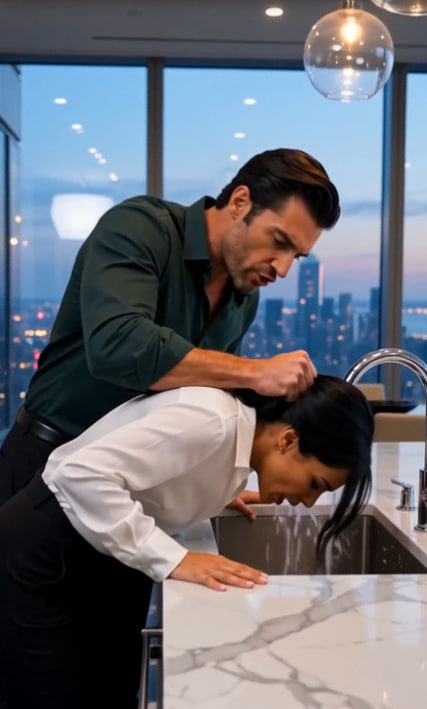
Ruby could not forget seeing her mother bent over the sink.
Consequences remained even after accountability.
That truth made the hopeful parts more honest.
Mara’s divorce had been final for almost three years.
She dated once.
Then twice.
Neither relationship became serious.
She discovered she did not need romance to prove recovery.
Her life was full.
Work.
Ruby.
Friends.
Elias.
Travel.
Quiet Saturday mornings.
A kitchen where nobody monitored her calls.
One day Rebecca asked whether Mara still loved Luca.
Mara considered.
“Yes.”
Rebecca nearly dropped her coffee.
“What?”
“Not the way you mean.”
“Explain.”
“I love who he was in some memories.”
“That sounds dangerous.”
“It used to.”
Mara smiled.
“Now it just sounds true.”
She loved the young man who danced badly in their first apartment.
The father who cried when Ruby was born.
The husband who sometimes made her laugh until she could not breathe.
She did not love being controlled.
She did not want him back.
Memory did not have to become desire.
That distinction felt like freedom.
Luca eventually completed domestic-violence intervention programming.
His therapist submitted a report to family court.
No claim of cure.
Only progress.
He accepted responsibility without blaming stress, Elias, Paolo, Mara, alcohol, business loss, or childhood.
That was the line Mara noticed.
No because.
The court expanded Ruby’s overnight schedule.
Mara agreed.
Ruby was nearly eleven.
Old enough to have preferences.
She wanted time with him.
Not unlimited.
Not as before.
Her own version.
Mara respected that.
After one weekend, Ruby came home carrying a shoebox.
“Dad gave me these.”
Inside were Luca’s childhood photographs.
Including the picture of him holding the blue ledger.
Mara frowned.
“Why?”
“He said he doesn’t want it.”
“The photograph?”
“The story.”
Mara looked at her.
“What story?”
“That he saved his family.”
Mara’s throat tightened.
Ruby continued.
“He said he hid the book because Grandpa was bad.”
“And now?”
“He said he was a kid.”
“Yes.”
“He said being a kid explains it.”
Mara waited.
Ruby finished:
“But being a grown-up means you stop using it as an excuse.”
Mara sat very still.
“Dad said that?”
“Yes.”
Ruby looked suspicious.
“Is it wrong?”
“No.”
Mara smiled through tears.
“It’s exactly right.”
Ruby picked up the photograph.
“What should I do with this?”
“Whatever you want.”
“Can the archive have it?”
“If your dad agrees.”
“He said yes.”
The photograph became part of the farmhouse exhibit.
Not labeled:
Luca Moretti, future criminal.
Instead:
Luca Moretti, age 11, holding the Sunridge ledger. Children can be used to protect adult secrets they do not understand.
Below it:
Adults remain responsible for what they choose after they understand.
On opening day Luca came privately before visitors arrived.
Mara happened to be there.
He stood before the photograph for a long time.
“You okay?” she asked.
He nodded.
“I hated that kid.”
Mara looked at him.
“Why?”
“Because he was stupid enough to believe Dad.”
“He was eleven.”
“I know.”
Mara remembered the kitchen.
The shove.
The lies.
Everything after.
“Maybe forgiving him is part of making sure you don’t become your father again.”
Luca looked at her.
“Have you forgiven me?”
The question was gentle.
No demand.
Mara considered it fully.
“I don’t know.”
Luca smiled faintly.
“Still?”
“Still.”
He nodded.
“That’s fair.”
Then he walked toward the open door.
Before leaving, he looked back.
“I’m glad you opened it that night.”
Mara thought of the shadow.
Ruby’s phone.
Her own shaking hand on the dead bolt.
“So am I.”
Luca left.
The door remained open behind him.
May you like



Mara did not close it.
---







