Chapter 19 - What Survived
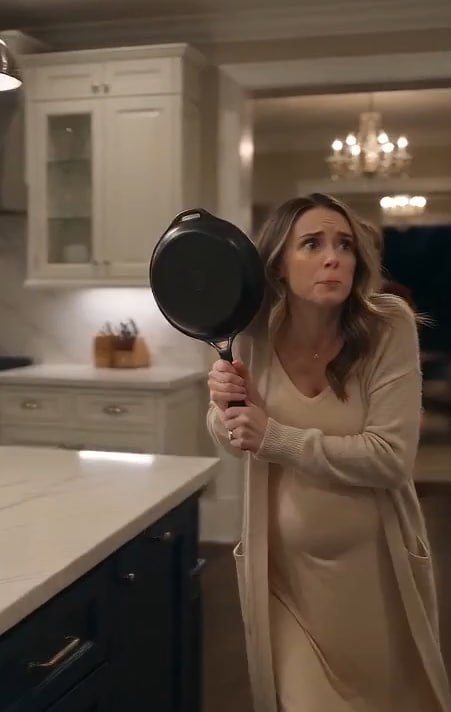
The divorce became final eleven months after the kitchen assault.
Claire kept her separate assets.
Ethan made no claim against them.
Their jointly owned marital home was sold.
Claire bought a smaller house twenty minutes from David.
No marble kitchen.
No interior surveillance system.
The first thing she purchased was a black cast-iron skillet.
David stared when he saw it.
“You’re joking.”
“No.”
“Same kind?”
“Exactly.”
“Why?”
Claire placed it on the stove.
“Because I like cast iron.”
David laughed.
That was part of recovery too.
Not letting a terrible moment permanently own an ordinary object.
Custody was complicated.
Ethan remained Rose’s legal father.
His incarceration meant contact was initially limited.
Family court ordered a structured plan for future supervised contact after release, subject to therapeutic recommendations and Rose’s welfare.
Claire did not try to erase him.
She also did not protect him from consequences.
Margaret and Richard had no independent access to Rose.
They could petition in the future if legally permitted, but the record against them was severe.
Claire stopped worrying about theoretical future litigation.
Laura told her that was also progress.
Mercer Development survived.
Barely.
The restructuring sold Bellweather Landing to another developer.
The lake house was sold.
Private aircraft contracts disappeared.
The Mercer Foundation was dissolved.
Independent directors replaced family control.
The Mercer surname remained on old buildings, but the family no longer ran the company as personal property.
One hundred sixty-one of the original 186 employees kept jobs through the restructuring.
Twenty-five did not.
Claire thought about those twenty-five often.
That pain mattered.
It simply did not mean she should have surrendered eleven million dollars and her autonomy to avoid it.
Richard’s false choice had been one of his strongest weapons:
Give us what we want or innocent people suffer.
Real life was more complicated.
Sometimes innocent people suffered because powerful people had already spent years refusing accountability.
Claire restarted work six months after Rose’s birth.
She did not need money.
She needed a part of herself untouched by Mercer history.
Her former software company invited her to advise a maternal-health project.
She accepted two days a week.
David became Rose’s favorite person almost immediately.
He claimed this was because of natural charisma.
Claire said it was because he made ridiculous animal noises.
Both were probably true.
Ethan wrote letters from custody.
Claire did not read all of them.
Some were about Rose.
Those she saved.
Some were about remorse.
Those she read only when she chose.
One letter said:
I used to think protecting a family meant preventing collapse. Now I think sometimes the collapse is what stops the harm.
Claire folded that one carefully.
Not because she forgave him.
Because it was true.
Ethan’s first supervised visit with Rose occurred after his release under court-approved conditions.
Rose was nearly two.
She did not know him.
That reality devastated him.
Claire watched from behind a one-way observation window with the therapist.
Ethan sat on the floor.
Rose stared at him suspiciously.
He offered her a wooden horse.
She took it.
Then walked away.
Ethan smiled anyway.
He did not force closeness.
He did not say, “I’m your father.”
He waited.
Claire’s throat tightened.
The therapist asked, “What are you feeling?”
“Angry.”
“Only?”
“No.”
“What else?”
“Sad.”
“Only?”
Claire smiled bitterly.
“No.”
She did not need to name everything.
Some emotions did not need court exhibits.
At the end of the visit Ethan stood.
Rose looked up at him.
“Bye.”
One word.
His eyes filled.
“Bye, Rose.”
Claire expected him to look toward the observation window.
He did not.
He left.
The therapist nodded.
“That was appropriate.”
Claire almost laughed at how low the bar once seemed.
Then she remembered the doorway.
The kitchen.
The slap.
The papers.
Appropriate was not small.
It was civilization.
Rules people followed precisely when emotion told them they were entitled to more.
That evening Claire cooked dinner in the cast-iron skillet.
Rose stood on a learning tower beside the counter, solemnly dropping sliced mushrooms into a bowl.
David arrived carrying a box.
“What’s that?”
“Your evidence.”
Claire stopped.
The hospital bag.
The black canvas looked exactly as she remembered.
A little dusty.
A numbered evidence tag tied to one handle.
Her chest tightened.
David set it on the table.
“You don’t have to open it.”
Claire looked at Rose.
Then at the bag.
“Yes, I do.”
Inside were the items returned after the criminal cases concluded.
Her slippers.
A phone charger.
Rose’s first onesie, never worn.
The cream blanket Claire’s mother had knitted.
No forged documents.
Those remained archived as court evidence.
Claire lifted the blanket and pressed it to her face.
It still smelled faintly like cedar from David’s attic.
Rose reached up.
“Mine?”
Claire laughed through tears.
“Yes.”
She wrapped her daughter in it.
The black bag sat open on the table.
May you like



Empty.
For the first time, there was nothing hidden underneath.







