Chapter 19 - The Cost of Winning
Sentencing did not happen immediately.
There were motions.
Asset hearings.
Restitution calculations.
Parallel proceedings involving Richard.
Shareholder claims.
Trust litigation.
The Sterling scandal became less dramatic and more expensive.
That was reality.
Richard pleaded guilty to major financial offenses.
His cooperation reduced his sentence but did not erase it.
Rachel Dean entered a cooperation agreement and pleaded guilty to offenses involving threats and fraudulent documents.
Her coercion by Victoria mattered at sentencing.
It did not make her innocent.
Caroline Voss lost her position as Sterling Urban’s general counsel after the independent review concluded her control failures were unacceptable, though investigators found no evidence she knowingly joined the fraud.
Samuel Brooks remained chairman.
Daniel Ross survived the audit after demonstrating he had repeatedly raised vendor-documentation concerns that Michael and others failed to prioritize.
Michael apologized to him.
Daniel said:
“I wrote you three emails.”
“I know.”
“You ignored two.”
“I know.”
“The third you forwarded to Victoria.”
Michael winced.
“I know.”
Daniel smiled slightly.
“Then we’re making progress.”
Michael’s derivative shareholder case settled.
He personally surrendered part of a performance award and accepted governance conditions.
The financial cost exceeded $12 million.
His reputation suffered.
He remained wealthy.
Still powerful.
But less insulated.
Sterling Urban recovered large portions of the Merriton losses through frozen assets, insurance, restitution, and cancellation of fraudulent property options.
Not all.
The company lost nearly $9 million permanently through fees and unrecoverable transfers.
Michael refused to describe recovery as “making everyone whole.”
It had not.
Bellrose’s building became permanently protected.
The court overseeing Laura’s trust concluded Victoria breached fiduciary duties.
An independent institutional trustee replaced her.
The academy received a new long-term lease at commercially reasonable but arts-supportive terms consistent with Laura’s instructions.
Madame Claire celebrated by increasing everyone’s rehearsal hours.
Emma called it tyranny.
Maya agreed.
Victoria’s sentencing occurred almost a year after the brooch fell.
Michael gave a victim-impact statement regarding Emma.
He did not ask for maximum punishment.
He described facts.
“My sister did not merely accuse my daughter.”
Victoria looked at him.
“She constructed an audience for the accusation.”
Michael continued.
“She selected an object emotionally important to our family. She chose a place where Emma felt safe. She used Emma’s friends and teachers as witnesses. She wanted humiliation to survive after the truth did.”
Victoria lowered her head.
“I failed too.”
The courtroom shifted.
“I hesitated when Emma told me she was innocent. I had warning signs about family governance and ignored them. I allowed my father’s secrecy to become our management culture. I cannot blame Victoria for those failures.”
He looked toward the judge.
“But none of my failures made my sister plant that brooch.”
Victoria cried silently.
The judge imposed a substantial prison sentence reflecting the financial crimes, planning, misuse of fiduciary positions, witness intimidation, and related conduct.
Richard’s sentence followed separately.
Victoria also faced restitution and forfeiture.
The family estate litigation ended with agreements that removed her from fiduciary control while preserving property rights she was still legally entitled to after restitution and judgments.
Michael did not try to strip her of every legitimate inheritance.
Jonathan asked why.
“Because punishment isn’t the same as rewriting Dad’s will.”
“You could fight.”
“I know.”
“You might win more.”
Michael looked at him.
“I’ve had enough people using legal power because they can.”
Emma later asked the same question.
“Aunt Victoria still gets some money?”
“Yes.”
“But she stole.”
“And she has to repay what the court orders.”
“Why does she get anything?”
“Because some property was legitimately hers before the crimes.”
Emma frowned.
“That’s annoying.”
“Law often is.”
She laughed.
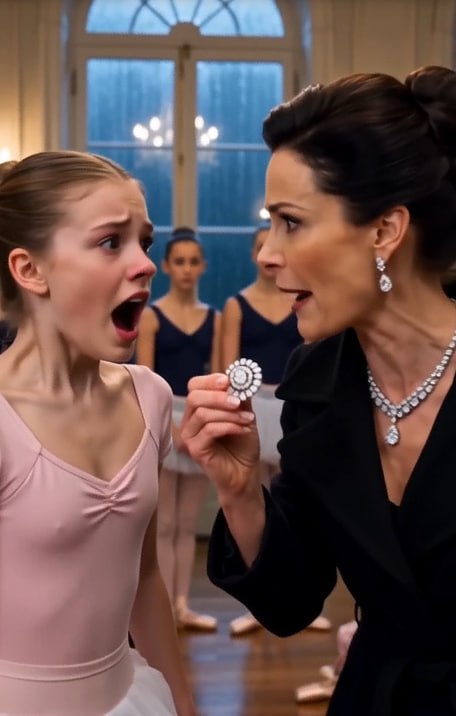
The diamond brooch became a separate issue.
Evelyn’s jewelry agreement had assigned it to Victoria.
But the brooch was forfeited temporarily as evidence and potentially available toward restitution depending on proceedings.
Victoria’s attorneys ultimately negotiated to transfer ownership voluntarily to the Sterling family restitution trust rather than sell it.
Michael could have purchased it.
He did not.
Emma asked:
“Why?”
“Because I don’t want to buy a memory.”
“What happens to it?”
“We decide later.”
Emma thought.
“Could Bellrose have it?”
Michael stared.
“Why would a ballet school want a diamond brooch?”
“Display it.”
Madame Claire immediately rejected the idea.
“This is an academy, not a crime museum.”
Emma laughed.
Eventually a different solution emerged.
The brooch was appraised.
A portion of other recovered assets satisfied required restitution.
The court released the brooch from evidence.
Victoria, through counsel, signed ownership over to Emma.
No message attached.
Emma received it on her fourteenth birthday.
She did not wear it.
She kept it inside a small velvet box.
Michael asked if she wanted it insured.
“Yes.”
“Smart.”
“Madame Claire says dancers should insure expensive costumes.”
“That is not the same.”
“I’m adapting.”
Then Emma said:
“I don’t want it because it’s diamonds.”
“Why do you want it?”
She thought.
“Because she tried to make it mean I was a thief.”
Michael waited.
“And now?”
“Now it just means she lied.”
A year earlier, Michael might have corrected her.
The brooch meant Evelyn.
Victoria.
Betrayal.
Evidence.
Inheritance.
Now he understood Emma had the right to choose its meaning.
At Sterling Urban, the board asked Michael whether he wanted to become chairman again after Samuel’s eventual retirement.
Michael declined.
CEO was enough.
Perhaps too much sometimes.
He created strict related-party governance rules.
No family vendor exceptions.
No private approvals.
No hidden estate-company overlap.
Jonathan joked:
“Arthur would complain for six months.”
Michael answered:
“Then it’s probably useful.”
The winter gala approached again.
Emma had earned the lead in a new Bellrose production.
Not because of the scandal.
Madame Claire made that painfully clear.
“Your turns improved.”
“Finally?”
“Do not become arrogant.”
On gala night Michael helped Emma fasten her costume.
Her pale-pink ballet bag sat nearby.
Still the same one.
He touched the zipper.
Emma noticed.
“You’re doing the thing.”
“What thing?”
“Thinking about it.”
Michael smiled.
“Yes.”
She opened the velvet jewelry box.
The diamond brooch glittered.
“Do you want to wear it?” he asked.
Emma looked at it.
Then shook her head.
“Not tonight.”
“Why?”
“It’s too heavy.”
Michael laughed.
Simple answer.
No symbolism required.
Emma zipped the brooch back into the velvet box.
Then placed the box inside a locked drawer.
This time nobody was hiding it.
Nobody was planting it.
Nobody was manufacturing a story.
It was simply stored.
Then Madame Claire called:
“Emma! Stage!”
Emma ran.
Michael followed toward the auditorium.
But before he entered, he heard a familiar small sound behind him.
Clink.
His heart stopped.
He turned.
The brooch lay on the dressing-room floor.
The velvet box had fallen when Emma closed the drawer too quickly.
For one terrible second, the old rehearsal hall came rushing back.
Then Emma looked down.
Saw the brooch.
And laughed.
“Dad, relax.”
Michael exhaled.
She picked it up herself.
May you like



“No one stole anything.”
And suddenly the sound that had once begun a nightmare meant nothing more than jewelry hitting the floor.







