Chapter 19 - What Consequences Cost
The criminal cases did not resolve quickly.
Nothing real did.
Eleven months passed.
Winter became spring.
Spring became summer.
The greenhouse remained closed until prosecutors released it.
Avery Heritage Properties survived by selling one non-core warehouse through a transparent board-approved transaction and refinancing legitimate debt.
Laura returned as CEO but made changes immediately.
No family member could hold unilateral control over financial approvals.
Outside directors chaired the audit committee.
Dual authentication required two independent officers.
Every related-party transaction had to be disclosed publicly to the board.
Trust was no longer a system.
Controls were.
Daniel left forensic accounting.
For several months he did nothing except heal.
Then he began teaching fraud examination part-time at a university.
On his first day, Laura teased him.
“Going to tell students not to hide evidence in children’s jewelry?”
“It’s slide four.”
Their marriage was not healed.
It was being rebuilt.
Those were different things.
They saw a therapist every Thursday.
Sometimes they left holding hands.
Sometimes they drove home separately.
But they no longer hid difficult truths to protect one another from them.
Sophie saw a child psychologist.
She stopped sleeping outside Daniel’s bedroom door.
Then she stopped checking whether the cellar hatch was locked.
Eventually, she stopped asking Laura to text whenever she walked outside.
Progress came quietly.
Celeste’s case ended in a negotiated plea.
The evidence was overwhelming.
The controlled greenhouse recording.
Mason’s testimony.
Owen’s cooperation.
The financial records.
The intercepted emails.
The voice messages.
The forged documents.
The locket card.
Celeste pleaded guilty in state court to conspiracy related to Daniel’s kidnapping, first-degree larceny, forgery, and risk-of-injury charges connected to Sophie.
Federal prosecutors separately charged her with wire fraud and conspiracy.
Her attorneys negotiated a global resolution.
The judge imposed an effective prison term of eleven years, followed by supervised release and restitution obligations that would consume most of Celeste’s remaining assets.
Owen received a substantial sentence too, reduced because of his cooperation.
Mason pleaded guilty to kidnapping-related offenses and attempted abduction of Sophie.
He received no sympathy from the judge.
At Celeste’s sentencing, Laura was asked whether she wished to speak.
She did.
Celeste sat at the defense table wearing a dark blue jail uniform.
Laura stood at the lectern.
“My sister loved me.”
The courtroom became silent.
“That is what makes this harder to explain.”
Laura looked at Celeste.
“She loved Sophie too.”
Celeste began crying.
“But love did not stop her from frightening my daughter, imprisoning my husband, stealing from our company, forging my signature, invading my privacy, and using every weakness she knew about me as leverage.”
Laura paused.
“I spent months asking whether she ever loved us.”
She shook her head.
“I think that was the wrong question.”
Celeste looked up.
“The right question is why she believed loving us gave her the right to control us.”
Laura’s voice broke.
“I hope prison is not the only consequence she carries. I hope one day she understands that being afraid of abandonment does not excuse becoming the person everyone must escape.”
Celeste covered her mouth.
Laura stepped away.
No triumph.
No relief.
Only truth spoken where it could not be edited.
Outside the courthouse, Sophie waited with Daniel.
She was ten now.
She had grown nearly two inches.
“Did Aunt Celeste cry?” she asked.
“Yes.”
“Did you?”
“Yes.”
“Did you forgive her?”
Laura looked at Daniel.
Then back at Sophie.
“I’m still figuring out what that word means.”
Sophie nodded as if that were acceptable.
Children sometimes tolerated ambiguity better once adults stopped lying about it.
That autumn, Celeste sent Sophie a letter from prison.
Laura opened it first with Sophie’s permission.
No excuses.
No claims that Owen made her do anything.
Celeste wrote:
I thought protecting our family meant making sure nobody could take anything away from me. I became the person taking things away from everyone else.
Sophie read the letter.
Then placed it in a drawer.
She did not reply.
Not yet.
Halcyon House changed too.
Laura considered selling it.
Daniel said the choice should be hers.
Sophie surprised both of them.
“I want to stay.”
“Why?” Laura asked.
“Because it’s ours.”
Laura hesitated.
Sophie added, “Not Aunt Celeste’s. Not Grandpa’s. Ours.”
So they stayed.
Workers repaired the greenhouse.
They replaced broken glass.
Rebuilt the heating system.
Removed the steel door from the underground cellar.
Laura refused to seal the space permanently.
“I don’t want a hidden room in this house ever again.”
Instead, the cellar became ordinary storage.
Bright lights.
White walls.
No locks.
Daniel stood at the bottom of the stairs the first time construction ended.
He stared at the place where he had spent nineteen days.
Laura stood beside him.
“You don’t have to come down here.”
“Yes, I do.”
“Why?”
“Because I want my body to learn I can leave.”
He walked to the far wall.
Touched it.
Then turned.
Together they climbed the stairs.
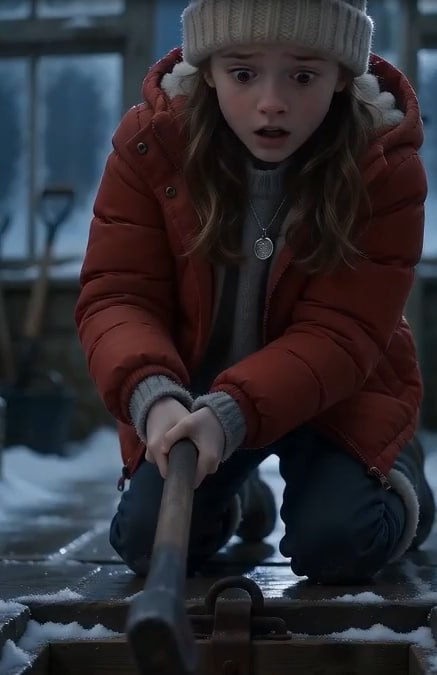
At the top, Sophie waited holding the old iron fireplace poker.
“Can I keep this?”
Laura smiled faintly.
“Why?”
“I broke Dad out with it.”
Daniel looked at the bent latch.
“Technically, you broke a latch.”
Sophie frowned.
“I broke Dad out.”
Daniel raised both hands.
“Absolutely.”
They mounted the poker on a wooden board beside the greenhouse door.
Not as a weapon.
As proof that a child had refused to ignore a voice everyone else had failed to hear.
Three weeks later, while Daniel was cleaning an old drawer in his desk, he found the silver locket.
He held it for a long time.
Then carried it downstairs.
Sophie was sitting at the kitchen island doing homework.
“I thought police had this.”
“They returned it months ago.”
“Why’d you hide it?”
“I didn’t know what to do with it.”
Sophie touched the repaired clasp.
“Is there anything inside?”
“Only your picture.”
“No secret card?”
“No.”
“No password?”
“No.”
She studied him suspiciously.
“Promise?”
Daniel smiled.
“Promise.”
She pushed it back.
“I’m not ready.”
“That’s okay.”
He placed it in the drawer beside her.
The locket remained there through winter.
Then one March morning, almost a year and a half after Sophie had heard the voice beneath the greenhouse floor, she took it out herself.
She held it in her palm.
And asked Laura a question.
“Do you think things can stop being scary?”
Laura looked toward the greenhouse.
“Yes.”
“When?”
“I don’t think they stop all at once.”
Sophie nodded.
Then she put the locket in her pocket.
Not around her neck.
Not yet.
May you like



But close.
It was enough.







