Chapter 1 - The Boy Beside the Stone Column
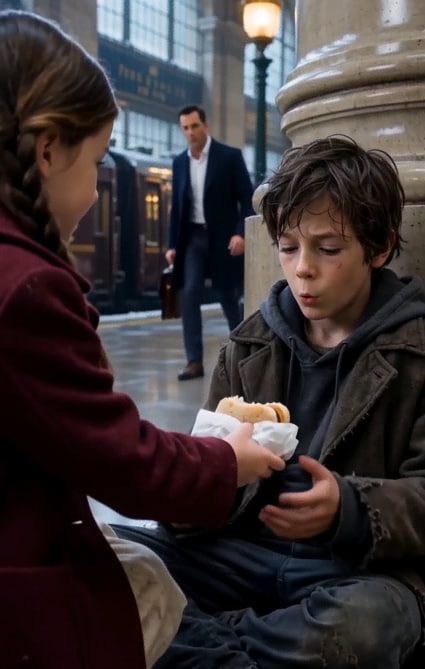
Daniel Ashford was about to tell his daughter not to go near the homeless boy.
Then the boy looked up.
Gray-blue eyes.
Messy dark hair.
And a tiny crescent-shaped scar beside his left eyebrow.
Daniel’s leather briefcase slipped from his hand.
It struck the marble floor of Ashford Grand Terminal with a crack that turned several wealthy travelers toward him.
“Caleb?”
The boy froze.
He was ten.
Thin enough that the shoulders of his old brown coat seemed too large for him. A second earlier, he had been sitting beside a stone column beneath the private railway terminal’s gold clock, watching businessmen, politicians, and old-money families pass through the exclusive departure hall without acknowledging him.
Only Sophie had stopped.
Daniel’s eight-year-old daughter had crouched beside the boy and held out the breakfast sandwich Daniel had bought her.
“You can have mine.”
The boy stared.
“Why?”
Sophie smiled.
“Because you’re hungry.”
That simple kindness was what brought Daniel across the terminal.
Now he could barely breathe.
“Caleb?”
The boy stood slowly.
“How do you know my name?”
Sophie looked between them.
“Dad… who is he?”
Daniel’s hands shook as he reached for his wallet.
Inside, behind his driver’s license, was a photograph he had carried for six years.
Rebecca.
His late wife.
And a four-year-old Caleb smiling beside her.
Daniel held the photograph near the boy.
The resemblance was not close.
It was devastating.
Same eyes.
Same narrow chin.
Same crescent scar from the day Caleb had fallen against Rebecca’s garden bench.
“My son…”
Caleb backed away.
“No.”
Daniel dropped to one knee.
“They told me you died.”
Caleb’s expression hardened through fear.
“They told me you didn’t want me.”
Daniel felt as though someone had struck him.
For six years he had mourned a dead child.
He had watched Rebecca sleep with Caleb’s photograph beneath her pillow until cancer took her three years later.
Meanwhile, Caleb had been alive somewhere believing his father had abandoned him.
“Who told you that?”
Caleb looked toward the tracks.
Before answering, he reached inside his coat.
He pulled out an old brass railway token.
Grace Nolan, the senior station attendant, was walking toward them.
When she saw the token, she stopped.
“Where did you get that?”
Caleb closed his fist.
“The man who left me here gave it to me.”
Daniel rose.
“What man?”
“I don’t know his name.”
Grace stepped closer.
“May I see it?”
Caleb hesitated, then opened his hand.
Grace examined the worn crest.
A winged wheel beneath a crown.
Her face changed.
“This belonged to the Ashford private family carriage.”
Daniel stared.
“My father’s carriage?”
Grace nodded.
The carriage had been decommissioned after Daniel’s father, Edmund Ashford, died two years earlier.
Caleb reached into his coat again.
A torn first-class ticket appeared.
Daniel took it.
His face went pale.
The ticket date was October 18.
Six years earlier.
Three days after Daniel had been given Caleb’s death certificate.
Someone had moved his son through Ashford Rail after Daniel had already been told there was no child left to find.
“Who brought you?”
Caleb swallowed.
“I never saw his face clearly. He wore a dark coat. He told me to stay here today and someone would come.”
Grace examined the ticket number.
Then looked toward the platform office.
“There may still be an archive record.”
Daniel followed her.
Inside the office stood an old locked cabinet inherited from the terminal’s previous security system.
Grace unlocked it.
Within were rows of numbered steel boxes once used to store private-carriage manifests, duplicate tickets, and security deposits.
She found Caleb’s number.
A narrow box sat inside.
No conventional keyhole.
Only a circular brass slot.
Daniel looked at Caleb’s token.
Caleb understood too.
He handed it over.
Daniel inserted the token.
CLICK.
The box opened.
Inside lay a sealed envelope and a Polaroid turned face-down.
Caleb went still when he saw the writing.
“That’s his handwriting.”
Daniel stared.
“The man who brought you?”
Caleb nodded.
Daniel tore open the envelope.
Inside was a handwritten instruction:
KEEP THE BOY OFF THE PUBLIC MANIFEST. USE CARRIAGE E-17. NO DIGITAL RECORD. THE FAMILY MUST BELIEVE THE IDENTIFICATION IS FINAL.
Below it were initials.
V.A.
Daniel’s chest tightened.
Sophie gripped his sleeve.
“Dad, what does it mean?”
He could not answer.
Caleb pointed toward the Polaroid.
“That’s him.”
Daniel slowly turned it.
At first he saw only a navy coat.
Then a hand resting on Caleb’s four-year-old shoulder.
A heavy gold signet ring.
Daniel stopped breathing.
He knew that ring.
Grace whispered, “You recognize him.”
Daniel lifted the photograph fully.
Victor Ashford stared back.
Daniel’s older brother.
The man who had stood beside Daniel at Caleb’s memorial.
The man who had helped Rebecca choose the flowers.
The man who had told Daniel to stop blaming himself.
Caleb whispered, “He’s the man who said you didn’t want me.”
Daniel’s knees nearly failed.
Sophie pressed closer to him.
Daniel looked again at his brother’s face.
Then at the written instructions.
Six years of grief rearranged themselves into something darker.
Victor had not failed to help Daniel find his son.
Victor had taken him.
And somewhere inside Ashford Rail, people had helped him make a four-year-old child disappear.
Daniel closed his hand around the brass token.
His grief turned into rage.
Then Grace said quietly:
“Mr. Ashford… there’s something else you need to know.”
Daniel looked at her.
Grace was staring at the initials on the note.
“I saw this instruction once before.”
Daniel’s voice became dangerously calm.
“When?”
Grace swallowed.
May you like



“The night Caleb disappeared.”
And Daniel realized the first person who could explain how his son had been stolen had been standing inside his family terminal all along.







