Chapter 10 - The Version Nobody Made
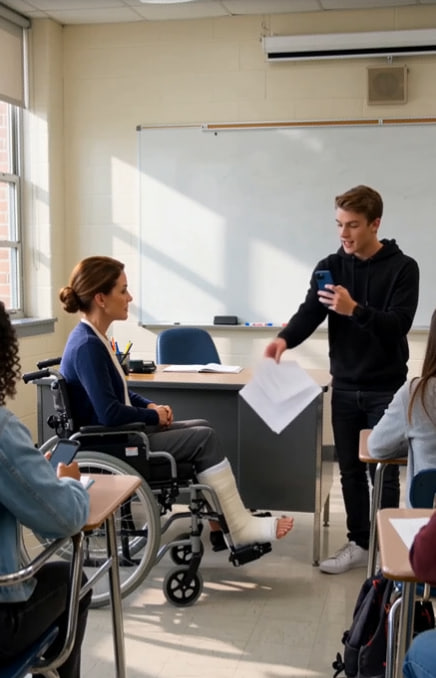
Tyler’s claim sounded like another lie.
Even Martin Grant thought so.
“What do you mean it isn’t your version?”
They were in the family kitchen again.
Tyler held his phone.
“I posted a video.”
“Yes.”
“But the one with the text calling her unstable isn’t mine.”
Laura frowned.
“What text?”
Tyler opened one of the most widely shared versions.
The video began with Rachel saying, “You are disrupting class.”
A caption appeared:
SHE’D BEEN SCREAMING AT HIM FOR FIVE MINUTES.
Later:
THIS TEACHER HAS BEEN UNSTABLE SINCE HER ACCIDENT.
Martin looked at his son.
“You didn’t write that?”
“No.”
“Why should I believe you?”
Tyler flinched.
Martin closed his eyes.
“I’m sorry.”
“No. You’re right.”
Tyler opened his editing application.
His exported file was thirty-three seconds long.
The viral version was thirty-eight.
Someone had added captions and a freeze-frame.
But the central edit—the removal of Tyler’s provocation—was his.
Laura said, “So you made the lie. Someone else made it uglier.”
Tyler looked sick.
“Yes.”
The family gave the device data voluntarily to Dr. Reed.
By then, the district’s concern had expanded beyond discipline.
Students were creating derivative versions faster than investigators could catalogue them.
One had inserted fake audio of Rachel saying, “I hate students like you.”
Another used slowed footage to make Tyler appear frightened.
A third replaced Rachel’s face with a distorted animation.
The original event was disappearing beneath layers of invention.
Dr. Reed documented only what mattered.
Tyler had planned the confrontation.
Tyler had recorded selectively.
Tyler had edited out his own provocation.
Tyler had posted the first misleading version.
Everything after that was relevant to harm, but not to determining his conduct.
That distinction became central at the academic-integrity hearing.
Rachel attended remotely with Denise.
Tyler attended with his parents and attorney.
The scholarship itself was not controlled by Westbridge. The school’s role was to determine whether the plagiarism violation occurred.
The evidence was simple.
Tyler’s essay.
Andrew Pike’s essay from the previous year.
Matching paragraphs.
Matching citation errors.
The leftover surname.
Tyler’s attorney did not seriously dispute copying.
Instead, he argued that Tyler had been under extreme stress and believed he had permission from Andrew to use the paper as a “model.”
Andrew, now a college freshman, appeared by video.
“I sent him my essay because he asked how I structured it,” he said.
“Did you give him permission to copy it?”
“No.”
“Did you tell him he could reuse your writing?”
“No.”
Tyler stared at the table.
The committee upheld the violation.
The zero remained.
A report would be sent to the Halston Scholarship Foundation under the terms of Tyler’s application.
When the meeting ended, Tyler did not speak until they reached the parking lot.
Then he turned to his father.
“There.”
Martin said nothing.
“I lost it.”
“We don’t know that yet.”
“Come on.”
Laura approached.
Tyler backed away.
“I did everything you wanted.”
Martin stared at him.
“No.”
“I got the grades.”
“You cheated.”
“I won elections. I did volunteer hours. I trained at five in the morning. I did every stupid thing that looks good on an application.”
Martin’s face tightened.
“And then you sabotaged yourself.”
Tyler laughed.
“Exactly.”
He turned away.
Martin said, “Tyler.”
“What?”
“I was wrong.”
Tyler stopped.
Laura looked at her husband.
Martin continued slowly.
“I made you believe one college and one scholarship determined whether you were successful.”
Tyler’s eyes filled.
Martin swallowed.
“I was wrong about that.”
Tyler wiped his face angrily.
“You don’t get to say that now.”
“I know.”
“You don’t get to spend years making everything life or death and then become reasonable after I blow it up.”
“I know.”
Tyler looked at him.
“Stop saying you know.”
Martin’s voice broke.
“Then tell me what I’m supposed to say.”
Tyler had no answer.
Across town, Rachel received an email from the district.
The formal investigation into her conduct was nearing completion.
No evidence supported Tyler’s allegations that she had harassed or threatened him.
She should have been relieved.
Instead, one paragraph held her attention.
The district anticipates clearing you to return to your teaching assignment Monday.
Monday.
Rachel looked around her apartment.
She imagined the hallway.
The whispers.
Students watching her every expression.
Phones in pockets.
Cameras everywhere even when invisible.
Claire found her still staring at the email.
“You’re going back?”
Rachel did not answer.
“You don’t have to.”
“Yes, I do.”
“No.”
Rachel looked at her.
Claire continued.
“You have to decide. That’s different.”
Rachel glanced toward the stack of ungraded essays.
For weeks, other people had controlled the frame.
Tyler.
The district.
Social media.
Commenters.
Reporters.
Maybe returning because everyone expected the triumphant teacher to walk—or roll—back into class would simply be another performance.
Rachel reached for her laptop.
She wrote one sentence to Principal Ellis.
I am not ready to return Monday.
Her finger hovered over Send.
May you like



Then she pressed it.
For the first time since Tyler lifted his phone, Rachel made a choice based on what she needed instead of what the story required.







