Chapter 7 - The Third Camera
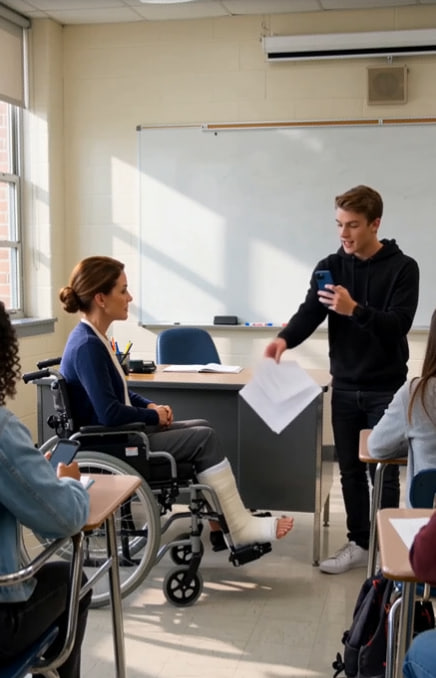
The third recording came from a place nobody had considered.
A laptop.
Jordan Lee had arrived early to Ms. Bennett’s class that morning for a remote college admissions interview scheduled during homeroom. When the interview ended, he had forgotten to close the video application.
His laptop continued recording locally for an automatic practice-review feature.
Jordan had not realized it until Friday.
The camera faced mostly toward him.
But the microphone had captured the room.
At 8:54 a.m., Tyler’s voice could be heard clearly.
“You ready?”
Marcus answered, “No.”
Tyler laughed.
“Relax.”
A chair scraped.
Then:
“I just need her angry for ten seconds.”
Marcus whispered something inaudible.
Tyler responded:
“People don’t watch beginnings.”
Thirty seconds later, Rachel entered.
The rest matched Ava’s recording.
Papers hitting the floor.
Tyler telling Rachel to yell.
Rachel refusing.
Tyler escalating.
Ava revealing her phone.
The principal arriving.
Jordan handed the laptop to his father before anyone at school touched it. His father, an accountant, copied the original recording and documented its creation timestamp.
Then they gave it to Dr. Reed.
The evidence was becoming difficult to explain away.
Tyler’s attorney tried anyway.
He argued that teenagers “exaggerate,” that the so-called script was joking, and that Tyler’s actions had been driven by “a sincere belief that Ms. Bennett was abusing her authority.”
Dr. Reed asked one question.
“If he sincerely wanted to document mistreatment, why did he instruct another student not to show what he did first?”
There was no useful answer.
Rachel learned about Jordan’s recording Monday morning.
She should have felt relief.
Instead she stared at the wall after Denise finished explaining it.
“How many recordings does it take before people stop calling this ambiguous?”
Denise closed her file.
“The investigation is moving strongly in your favor.”
“That wasn’t my question.”
“No.”
Rachel rolled toward the window.
Outside, children from the elementary school across the street were being led to recess.
“I became a teacher because I thought facts mattered.”
“They do.”
“Eventually.”
Denise said nothing.
Rachel looked back at her.
“That word is doing a lot of work.”
Her phone rang.
Unknown number.
Denise shook her head.
“Don’t answer.”
It stopped.
Then came a voicemail.
Rachel played it on speaker.
A woman’s voice said:
“My daughter had you three years ago. You helped her when she was failing. I don’t believe that video.”
Rachel froze.
The caller continued.
“You probably won’t remember Emma Carlisle, but she remembers you. So do I. That’s all.”
The message ended.
Rachel lowered the phone.
Denise smiled faintly.
“Facts aren’t always the only thing people remember.”
Rachel looked away before emotion reached her face.
At school, Tyler finally returned for a limited disciplinary meeting.
He wore a gray sweatshirt instead of his usual school jacket.
His father, Martin Grant, walked beside him.
Martin was not the caricature Rachel’s imagination had begun creating.
He was tired-looking, broad-shouldered, and visibly angry.
He did not shout.
That made him more intimidating.
Principal Ellis met them in the conference room with Dr. Reed and the district’s student-services director.
Tyler was informed that the investigation now included evidence he had intentionally staged the classroom confrontation.
Martin spoke first.
“My son made a bad decision after weeks of pressure.”
Dr. Reed answered.
“We’re determining exactly what decision he made and why.”
“You’re treating him like a criminal.”
“No one has called him a criminal.”
“You’re collecting children’s private messages.”
“With consent.”
“You’re interviewing every student who ever disliked him.”
“We are interviewing witnesses.”
Martin leaned back.
Tyler said nothing.
Principal Ellis turned to him.
“Tyler, do you still maintain that Ms. Bennett initiated the confrontation?”
His eyes remained on the table.
“My video shows what happened.”
Dr. Reed pushed a transcript toward him.
“So does this.”
Tyler read the first line from Jordan’s recording.
I just need her angry for ten seconds.
His face changed.
Martin looked at him.
“What is that?”
Tyler swallowed.
“A joke.”
Martin read further.
People don’t watch beginnings.
“Tyler.”
“It’s out of context.”
Dr. Reed did not react to the irony.
“What context would change its meaning?”
Tyler said nothing.
Martin’s face had gone pale.
For the first time, it appeared that he might not have known everything his son had done.
Principal Ellis asked, “Did you deliberately provoke Ms. Bennett so you could edit her response?”
Tyler stared at the transcript.
His voice came out low.
“She ruined my scholarship.”
“No,” Principal Ellis said. “Your plagiarism threatened your scholarship.”
His jaw clenched.
“She wanted me to fail.”
“Did she tell you that?”
“No.”
“Did she alter your grade unfairly?”
“She gave me a zero.”
“Under a policy you were aware of.”
Tyler looked toward his father.
Something in Martin’s expression stopped him.
It was not anger.
It was disappointment.
Tyler looked away.
The meeting ended twenty minutes later.
Outside, Martin walked toward the parking lot.
Tyler followed.
“Dad.”
Martin kept walking.
“Dad.”
Finally Martin turned.
“Did you plan it?”
Tyler’s eyes filled with panic.
“I can explain.”
“That is not what I asked.”
Tyler looked at the pavement.
Martin’s voice dropped.
“Did you plan the video before you went into that classroom?”
Tyler said nothing.
His silence answered.
Martin stepped back as though his son had struck him.
Then Tyler said the one thing neither the school nor Rachel had known.
“I had to.”
Martin stared at him.
“Why?”
May you like



Tyler’s face twisted.
“Because you told me I had one chance left.”







