Chapter 20 - What Was Never Temporary
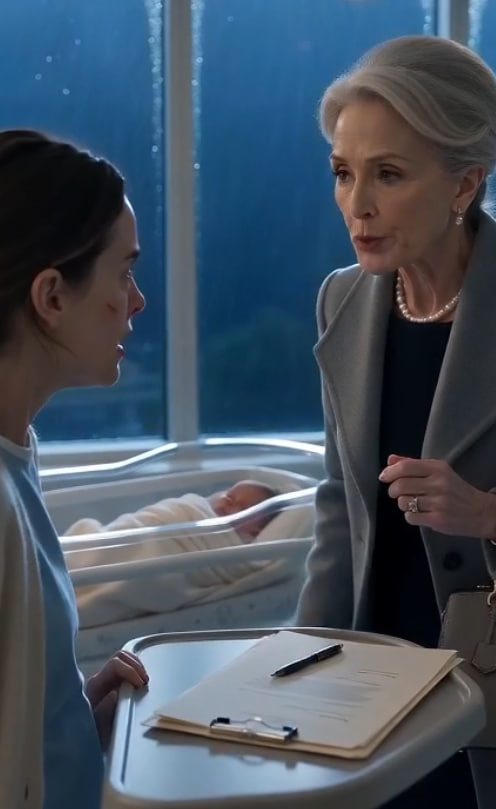
Nora was nine months old when Grace returned to St. Victoria Medical Center.
Not as a patient.
Not for court.
Not to search restricted records.
She had been invited to speak at the launch of the hospital’s new independent patient-privacy and maternal-advocacy program.
Grace almost declined.
Then Dana Cole called.
“If people like Eleanor are the only ones comfortable standing in hospital boardrooms, nothing changes.”
Grace agreed.
The rain had returned that morning.
Not violent.
Soft.
Steady.
It reminded Grace of the night Nora was born.
She stood outside the maternity suite before the event.
The room had been renovated.
New chair.
New table.
Same windows.
For a moment she remembered Eleanor’s hand around her wrist.
The slap.
The cream-colored papers hitting the table.
You were temporary.
The baby isn’t.
Grace closed her eyes.
The door opened.
Ethan stood behind her holding Nora.
“You okay?”
“Yes.”
He did not ask whether she was sure.
He had finally learned that Grace could name her own feelings.
Nora wore a cream sweater.
Grace smiled.
“Where did that come from?”
“Your mother.”
“Of course.”
Ethan looked nervous.
“Bad cream?”
Grace laughed.
“No. Just memories.”
Their marriage was not repaired.
It was being rebuilt.
Slowly.
Ethan worked for a small healthcare compliance nonprofit now.
The salary would once have embarrassed him.
That embarrassment had become useful.
Amelia lived forty minutes away.
Caleb spent weekends with Grace and Ethan often.
Western Pacific continued managing his trust interest.
Nobody in the family could use a child’s voting shares as personal leverage.
Miriam had sold the last interest connected to her late husband’s clinic and completed her regulatory settlement.
She and Grace spoke weekly.
Some conversations were painful.
Some were ordinary.
Ordinary had become a gift.
Eleanor awaited trial under home restrictions approved by the court.
Grace had seen her once since their conference-room meeting.
No shouting.
No forgiveness ceremony.
Just two women acknowledging that truth does not always restore relationships.
Before Grace’s speech, Dana brought her a small framed display.
Inside were two photocopied newborn bracelets.
Caleb’s.
Nora’s.
Beneath them was a sentence:
A PATIENT RECORD BELONGS TO THE PATIENT—NOT TO THE POWER OF THE FAMILY AROUND THEM.
Grace’s throat tightened.
“I love it.”
Dana smiled.
“There’s something else.”
She handed Grace an envelope.
Inside was the cream hospital blanket Nora had used after birth.
Grace stared.
“How?”
“Your mother saved it.”
Grace laughed through tears.
“I thought it was lost.”
“Miriam found it in the bag you left during the emergency discharge.”
Grace touched the soft fabric.
For months, the blanket had existed in her memory beside violence.
Rain.
Custody papers.
Fear.
Now it simply smelled like clean cotton.
Nora reached for it.
Grace wrapped it around her daughter.
The transformation was almost painfully simple.
Objects did not choose their meanings.
People did.
The auditorium filled.
Doctors.
Nurses.
Hospital administrators.
Trust officers.
Compliance employees.
Several Ashford Medical directors.
Miriam sat near the back beside Amelia and Caleb.
Ethan stood against the wall holding Nora.
Grace stepped to the podium.
She did not tell the entire scandal.
Trials were pending.
Privacy still mattered.
Instead she spoke about authority.
“Power becomes dangerous when people begin treating access as ownership,” she said.
“A hospital executive believes she owns the record. A trustee believes she owns the beneficiary. A parent believes protecting a child means controlling the truth. A spouse believes love allows him to decide what his wife can survive.”
Ethan lowered his eyes.
Grace continued.
“I learned something painful. Secrecy can begin with good intentions. So can manipulation. The difference is whether the person being protected is allowed to choose.”
Miriam began crying.
Grace saw her.
She continued.
“When my daughter was eighteen hours old, someone placed a guardianship document in front of me and told me I was temporary.”
Silence filled the auditorium.
“At the time, I thought the cruelest part was the insult.”
Grace looked at Nora.
“I was wrong.”
Ethan met her eyes.
“The cruelest part was the idea beneath it—that a mother, a child, a marriage, a family, even truth itself could be treated as temporary when it became inconvenient to someone with more power.”
She paused.
“Power is temporary.”
The words settled.
“Control is temporary. Money changes hands. Companies are sold. Trustees are removed. Careers end. Reputations collapse.”
Grace looked toward Caleb.
“But the consequences of what we do to one another remain.”
After the speech, Miriam approached.
She touched the edge of Nora’s cream blanket.
“I remember wrapping Caleb in one just like this.”
Amelia stood beside her.
Her expression tightened.
Miriam withdrew her hand.
“I’m sorry.”
Amelia looked at Caleb.
Then at Miriam.
“I know.”
The same answer Grace had finally given.
Not absolution.
Recognition.
Ethan joined them.
For a few minutes the two families stood together.
Not healed.
Not innocent.
Present.
That was enough.
Outside the hospital, Grace stopped near the parking structure.
Ethan looked at her.
“What?”
She reached into her purse.
The black restricted-access card.
He laughed softly.
“You still carry that?”
“Sometimes.”
“It doesn’t work anymore.”
“I know.”
The hospital had deactivated it months ago.
Grace held it against the old electronic reader anyway.
Nothing happened.
No beep.
No green light.
No ACCESS GRANTED.
She smiled.
Ethan asked, “Disappointed?”
“No.”
She returned it to her purse.
“The first time that card opened a door, I thought it gave me access to the truth.”
“And now?”
Grace looked back through the glass doors.
At Miriam.
At Amelia.
At Caleb.
At Nora wrapped safely in cream.
“At first it only gave me access to a room.”
She took Ethan’s hand.
“The truth came from people finally deciding to stop locking it away.”
He squeezed her fingers.
Grace did not promise forever.
Neither did he.
Forever was another word families sometimes used to avoid doing the work of today.
They walked toward the car.
Nora made a sleepy sound against Ethan’s shoulder.
Grace tucked the cream blanket beneath her daughter’s chin.
And suddenly Eleanor’s words returned one last time.
You were temporary.
The baby isn’t.
Grace understood them differently now.
Eleanor had meant that Grace could be removed.
Replaced.
Erased.
But Grace had survived long enough to discover the truth buried inside the cruelty.
Nora was not an heir first.
Not a trust beneficiary.
Not a voting strategy.
Not an Ashford asset.
She was a child.
Caleb was not a hidden trigger inside a legal document.
He was a child.
And motherhood was not ownership either.
Grace’s job was not to control Nora’s life.
It was to make sure nobody—including Grace herself—ever confused love with control again.
Ethan opened the car door.
Grace paused before getting in.
“Do you remember what your mother called me?”
He looked at her.
“Temporary.”
Grace smiled faintly.
“She was right about one thing.”
Ethan frowned.
“What?”
Grace looked back at St. Victoria, at the building where the worst night of her life had begun and where the truth had finally become impossible to bury.
“Everything she was trying to hold onto was temporary.”
She kissed Nora’s forehead.
“The people weren’t.”
Then Grace climbed into the car beside her family.
May you like



And this time, no one else had written the papers deciding where they would go.
THE END







