Chapter 20 - Being Pregnant Isn’t a Career
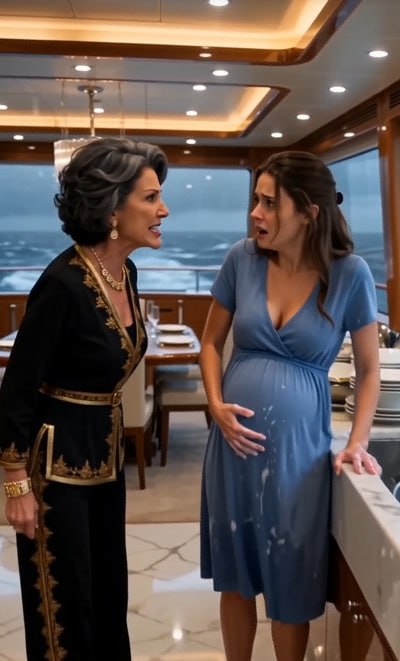
Seven months after the frying pan crossed the galley, Laura stood in a very different kitchen.
It was smaller.
No marble island the size of a dining table.
No champagne glasses.
No uniformed crew.
No yacht rocking gently against a private marina.
Sunlight entered through ordinary apartment windows.
A baby monitor sat beside a bowl of fruit.
From the next room came a sleepy little cry.
Laura smiled.
Her daughter, Sophie, was six weeks old.
Laura had chosen the name simply because she loved it.
No family politics.
No legacy demand.
No hidden condition.
Just Sophie.
Laura turned off the stove and lifted a stainless-steel frying pan.
For half a second, memory struck.
Victoria’s arm.
The pan flying.
The impact against Laura’s shoulder.
Adrian’s hand against her face.
Then Sophie cried again.
Laura carried the pan calmly to the sink.
Metal touched stainless steel with a loud clang.
She froze.
Then she breathed.
The sound was only a sound now.
Her phone buzzed.
Adrian.
Downstairs. May I come up?
It was his parenting afternoon.
Laura replied.
Yes.
He entered five minutes later carrying diapers, formula, and far too many baby clothes.
Laura looked at the bags.
“You know she grows out of things every twelve minutes.”
“I’m learning.”
He looked healthier.
Quieter.
Counseling had changed the way he occupied a room. He no longer reacted to discomfort by immediately trying to control it.
His relationship with Victoria remained limited.
Supervised by boundaries he had once considered cruel.
Victoria had sold her Palm Beach residence and other assets as part of civil settlements and trust restitution.
The criminal investigation continued.
Marcus had entered a guilty plea to document falsification and conspiracy-related charges under an agreement requiring cooperation; sentencing remained pending.
Walter faced separate fraud and obstruction-related proceedings after evidence showed he had attempted to intimidate Laura and conceal his financial interest in Hudson.
Victoria had not gone to prison in some dramatic overnight ending.
Her lawyers fought every allegation.
She denied criminal intent.
But she had lost the things she valued most as symbols of control.
The chair.
The trust.
The yacht.
Her command over Adrian.
Vale Meridian had eventually recovered enough through insurance, settlements, and asset claims to stabilize.
Not completely.
Scars remained.
That mattered to Laura.
Consequences should not be magical.
Adrian walked to Sophie’s bassinet.
“Hi,” he whispered.
Sophie waved one tiny fist.
His face softened.
Laura watched him lift their daughter carefully.
For a moment grief passed through her.
They could have been a family in another life.
Then she remembered there had been no other life.
Only choices.
Adrian looked at her.
“The divorce decree came through.”
Laura nodded.
“So mine did.”
Neither smiled.
Neither cried.
“It feels strange,” he said.
“Yes.”
“I’m sorry.”
“I know.”
This time those words did not reopen anything.
They were simply true.
Adrian noticed the frying pan in the sink.
His face tightened.
Laura followed his gaze.
“You don’t need to do that.”
“Do what?”
“Look guilty every time you see cookware.”
He almost laughed.
Almost.
Then he became serious.
“I still see that morning.”
“So do I.”
“The camera.”
“Yes.”
“I thought the worst moment was when the footage showed Mom throwing the pan.”
Laura shook her head.
“It wasn’t.”
“The slap.”
“That was worse.”
He lowered his eyes.
“But even that wasn’t the most important moment.”
He looked up.
Laura walked toward the baby monitor.
“The most important moment was when I looked at the camera.”
Adrian listened.
“Before that, I was begging you to believe me. After that, I stopped begging.”
He understood.
“You knew there was proof.”
“No.”
Laura shook her head.
“I knew there might be proof.”
She looked directly at him.
“What changed was that I believed myself even if you didn’t.”
Adrian swallowed.
“That’s what I took from you.”
“For a while.”
“I’m sorry.”
“I know.”
Sophie made a small noise against his chest.
Laura smiled.
Adrian smiled too.
Then the doorbell rang.
Evelyn entered carrying takeout and a folder.
“You two look suspiciously civilized.”
“We’re trying something new,” Laura said.
“Accountability?”
Adrian replied, “Apparently.”
Evelyn put the folder down.
“What is that?” Laura asked.
“Your new company paperwork.”
Laura had spent the last three months building an independent financial-risk advisory firm with two former colleagues.
It specialized in governance, fraud controls, and family-owned companies where personal power often blurred professional rules.
She had hesitated over the name.
Finally she chose Clearline Advisory.
Evelyn handed her the state confirmation.
“You’re official.”
Laura stared at the document.
Adrian smiled.
“Congratulations.”
“Thank you.”
Evelyn glanced toward the kitchen.
“You cooked?”
“Attempted.”
“Dangerous.”
Laura laughed.
A real laugh.
Then she remembered Victoria’s voice from seven months earlier.
Being pregnant isn’t a career.
At the time, the insult had been designed to reduce her.
To imply that carrying a child made her dependent.
Useless.
A woman living off Adrian’s money.
Now Laura looked around.
Her daughter.
Her company paperwork.
Her own apartment.
Her own accounts.
Her own choices.
Pregnancy had not been a career.
Victoria had been right about that one sentence in the ugliest possible way.
Pregnancy had been something more vulnerable and more powerful.
A season in which Laura had discovered exactly what she would no longer tolerate.
Adrian handed Sophie back.
“I’ll pick her up Saturday at ten?”
Laura nodded.
“Ten.”
He walked toward the door.
Then stopped.
“Laura?”
“Yes?”
“Thank you for letting me become a better father than I was a husband.”
Her throat tightened.
“Don’t thank me.”
He waited.
“Prove it to her.”
Adrian looked at Sophie.
“I will.”
After he left, Evelyn opened the takeout.
Laura placed Sophie in her bassinet.
Then she returned to the kitchen.
The frying pan remained in the sink.
Laura picked it up.
Evelyn noticed.
“You okay?”
Laura looked at the ordinary piece of metal.
Seven months earlier, another pan had been evidence that nobody believed her until a camera spoke.
Today it was simply something she had used to cook dinner in her own home.
“Yes,” Laura said.
She washed it.
Dried it.
Hung it above the stove.
Then she switched off the kitchen light and carried her daughter into the quiet living room.
Behind her, the pan caught one last line of evening sunlight.
Not a weapon.
Not evidence.
Not a symbol of humiliation.
Just hers.
And this time, no camera was needed to prove what happened next.
May you like



Laura already knew who she was.
THE END







