Chapter 11 - The Five Minutes
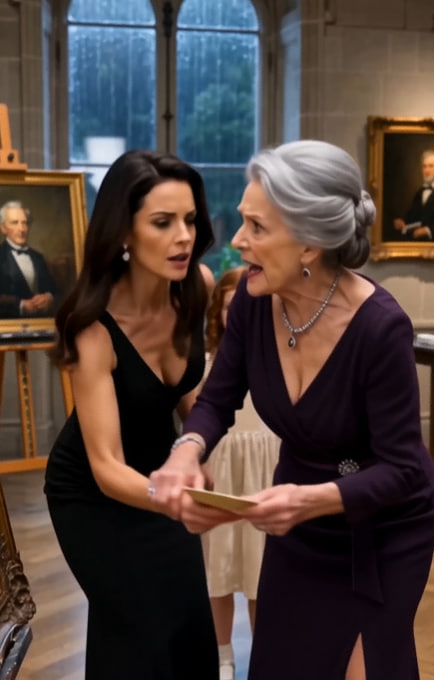
Helena admitted searching the restoration room.
Not immediately.
Not voluntarily.
Her lawyers did it after the timeline document made denial impossible.
She still refused the word “search.”
“I was looking for Arthur’s medication.”
Detective Ortiz asked, “Inside painting storage?”
“He kept things everywhere during those final months.”
“You wrote, ‘Could not locate envelope.’”
Helena looked at the investigator.
“My husband had threatened to alter his estate plan.”
“So while he was unresponsive on the floor, you looked for a legal document?”
“He was breathing.”
“Why not call emergency services immediately?”
“I panicked.”
Claire almost laughed when she heard.
Helena had spent seven years dismissing everyone else’s fear as weakness.
Now panic was her defense.
Medical experts reviewed Arthur’s records.
Their conclusion frustrated everybody who wanted certainty.
Arthur had suffered a catastrophic cardiac event.
Immediate treatment might have improved his odds.
It might not have changed the outcome.
No responsible physician would claim five minutes definitely killed him.
Claire accepted that.
Thomas struggled.
“What if she had called?”
Claire refused to answer a question nobody could resolve.
“What if he could have lived?”
“We don’t know.”
“What if—”
“Thomas.”
He stopped.
Claire softened her voice.
“You spent seven years avoiding facts. Don’t replace that with torturing yourself over unknowable possibilities.”
He stared at her.
“That sounds like forgiveness.”
“It isn’t.”
She walked away.
The codicil hearing resumed.
This time Helena testified.
She wore navy blue rather than purple and spoke calmly.
Arthur, she said, had become vindictive after discovering Thomas’s business problems. He wanted to punish his family. He overvalued paintings while underestimating real estate expenses. She had made difficult decisions to preserve Whitmore House.
Her attorney asked the central question.
“Did you knowingly conceal a valid codicil after your husband’s death?”
Helena answered, “No.”
Mr. Vale’s documentation contradicted her.
An archived certified letter sent five days after Arthur’s death stated clearly:
I witnessed Arthur execute a codicil on March 4. The original is presently missing. No estate petition should represent that no later instrument exists without disclosing this fact.
The letter was addressed to Helena and Thomas.
Thomas testified he never saw it.
The family office mail log showed Helena signed for it personally.
Her attorney shifted strategy.
Perhaps the original had been destroyed by Arthur, which under some circumstances could indicate revocation.
Then Maya testified about the portrait.
The envelope had been sealed.
Placed deliberately behind backing material.
Arthur’s environmental log and Nora’s testimony supported that he accessed restoration the night he died.
The physical evidence showed the envelope had remained undisturbed until Helena cut into the portrait seven years later.
Arthur had hidden it.
He had not destroyed it.
The judge asked Helena one question.
“Why were you cutting open the portrait?”
For the first time, Helena hesitated.
“My granddaughter told me about the video.”
Claire turned toward Ava’s guardian.
So that was how Helena finally knew.
Ava had watched Arthur’s recording in the mansion months earlier. Helena must have overheard something.
“When?” the judge asked.
Helena’s voice dropped.
“Two days before the restoration incident.”
“You learned Arthur’s video showed the portrait?”
“Yes.”
“And you inferred the missing codicil might be hidden there?”
“Yes.”
“Why did you not notify the estate court?”
Silence.
“Mrs. Whitmore?”
Helena looked at the judge.
“Because I believed the document had already caused enough damage.”
Claire closed her eyes.
There it was.
Not full confession.
But enough.
The judge admitted the codicil to probate subject to final accounting issues.
Arthur’s final testamentary plan was legally recognized.
Ava was the beneficiary of a trust holding the residuary estate.
Claire was not named trustee.
Thomas was not named trustee.
Arthur had appointed an independent trust company and Mr. Vale as trust protector until Ava turned twenty-five.
Claire felt relief.
Helena had spent weeks accusing her of engineering the inheritance for control.
Arthur had designed the document so neither parent could control the money.
The provision protected Ava not only from Helena.
It protected her from Claire and Thomas too.
Claire respected him more for that.
Outside court Thomas approached.
“So it’s final.”
“The codicil is admitted.”
“My daughter owns Whitmore House.”
“Her trust does.”
He nodded.
“I’m glad you’re not trustee.”
Claire looked at him sharply.
He almost smiled.
“I mean that as a compliment.”
“Explain quickly.”
“You won’t have to spend the next eighteen years wondering whether every decision you make for Ava is because you’re her mother or because you control her money.”
Claire’s irritation softened.
“That may be the first intelligent thing you’ve said in weeks.”
“I’m improving.”
“Slowly.”
He accepted that.
Mr. Vale joined them holding a thin folder.
“There is a document I am now authorized to disclose.”
Claire frowned.
“Another codicil?”
“No. A letter of wishes Arthur left with my office. It had no legal effect unless the codicil was found and admitted.”
Thomas stared.
“You had this for seven years?”
“I had instructions not to open it unless the codicil surfaced.”
“Why?”
“Because Arthur was tired of secrets being mistaken for power. He wanted this one tied to a legal event.”
They opened it together.
Arthur had written separately to Ava.
She would not read the full letter until adulthood, but Mr. Vale showed them one paragraph relevant to the estate.
Whitmore House should never become a palace for one frightened family. If the collection can be recovered, I hope the house becomes a place where people learn how art is cared for, questioned, restored, and sometimes corrected. Nothing beautiful is diminished by telling the truth about its damage.
Claire thought of Helena’s blade cutting through the portrait.
Then of Maya carefully documenting the tear instead of hiding it.
Thomas read the final sentence twice.
He whispered, “He knew.”
“Knew what?” Claire asked.
“That we would try to preserve the surface.”
Mr. Vale closed the folder.
“There is still another problem.”
Claire looked at him.
“What?”
“The trust may own the house now.”
He glanced toward the mansion.
“But the foundation may have a claim against it for the millions Helena diverted.”
Ava had inherited Whitmore House.
May you like



She had also inherited the consequences of what her family had done inside it.
---







