Chapter 5 - The Dead Man’s Warning
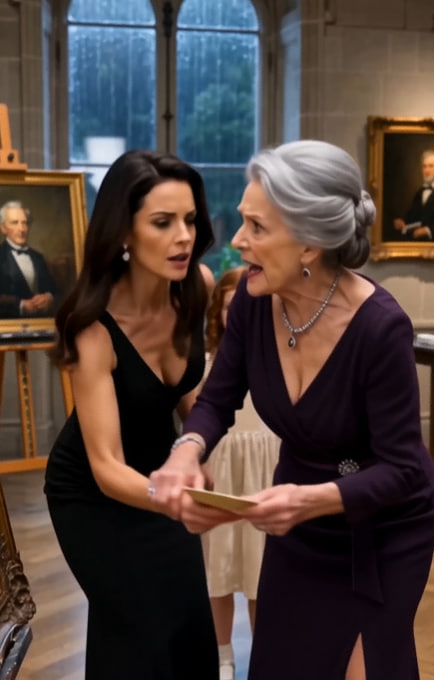
Claire read Arthur’s draft email three times.
The wording did not accuse Helena of harming him.
It did something more credible.
It documented fear.
Elias,
I have confirmed that at least three works have been removed or substituted without my authorization. Thomas admitted his role in the Red Harbor sale. Helena refuses to disclose the remainder. I will call you tomorrow regarding the codicil and the foundation vote.
If anything happens to me before Monday, do not let Helena control the collection. The records marked with Ava’s star must be reviewed independently.
The email had never been sent.
Arthur died early Sunday morning.
The board meeting removing Helena and Thomas was scheduled for Monday.
Claire immediately understood what everyone else would think.
She also understood the danger of thinking too quickly.
“How did Arthur die?” Maya asked.
“Heart attack,” Thomas said.
“Was there an autopsy?”
Helena’s voice came from the doorway.
“No.”
Claire looked at her.
“Why not?”
“My husband had coronary disease.”
Thomas nodded slowly.
“Dad had been taking medication for years.”
Claire remembered that too.
Arthur’s death had shocked them, but not because it was medically impossible.
He had experienced chest pain twice in the previous year.
Helena’s eyes moved around the room.
“I know what you are all doing. You are turning theft allegations into murder because theft is no longer dramatic enough.”
Claire folded the email.
“No one accused you of murder.”
“Not yet.”
Mr. Vale, who had just entered, said calmly, “Then help establish the timeline.”
Helena laughed.
“You want me to reconstruct the worst night of my life seven years later?”
“Yes.”
She looked at him with open hatred.
Arthur had eaten dinner alone in his study that Saturday.
Helena claimed she went to bed around eleven.
Thomas had already returned to his apartment in Manhattan.
At 2:20 a.m., Helena said, she woke and found Arthur collapsed near the study desk.
Paramedics arrived at 2:34.
He was pronounced dead at the hospital.
Simple.
Documented.
Except Nora Bell remembered it differently.
They found her the next morning in the kitchen polishing an already spotless silver tray because she did that when anxious.
Nora had worked at Whitmore House for twenty-three years.
When Claire asked about Arthur’s final night, she stopped polishing.
“I promised Mrs. Whitmore I would never discuss family arguments.”
“Arthur’s estate may have been administered under the wrong will,” Claire said. “And paintings may have been illegally sold.”
Nora looked toward the door.
Then at Ava, who was sitting across the kitchen doing a puzzle with Maya.
“I heard them fighting.”
“Arthur and Helena?”
“Yes.”
“What about?”
“Mr. Arthur said, ‘You will not sell another piece.’ Mrs. Whitmore said he was going to destroy the family because he cared more about dead painters than living people.”
Claire glanced at Thomas.
His eyes were fixed on the floor.
“What time?”
“About ten.”
“What happened after?”
“Mrs. Whitmore went upstairs.”
“And Arthur?”
“He stayed in his study.”
“Did you see him again?”
Nora hesitated.
“A little after midnight.”
Helena had said she found him after two.
Claire leaned forward.
“How did he look?”
“Upset. Tired. Alive.”
“Was anyone with him?”
“No.”
“What was he doing?”
“He asked me where the old portrait crates were stored.”
Claire and Maya exchanged a glance.
The envelope.
“He was hiding the codicil that night,” Claire whispered.
Nora nodded.
“He had a cream envelope.”
Thomas closed his eyes.
“Did he say anything else?”
Nora’s face softened.
“He said, ‘Tomorrow I fix what fear has made us become.’”
The room remained silent.
Then Ava looked up from her puzzle.
“Grandpa sounds sad.”
Nora wiped one eye.
“He was.”
Claire asked, “When did Helena come downstairs?”
“I don’t know.”
“You were awake.”
“I went to my room around twelve-thirty.”
Mr. Vale arrived with archived telephone records later that afternoon.
Arthur had called him at 12:17 a.m.
“I was asleep,” Mr. Vale said. “My phone was downstairs. I found the missed call in the morning after I learned he had died.”
“Did he leave a voicemail?”
“The old service indicated one had been recorded, but when I accessed my mailbox, it was gone.”
Thomas frowned.
“Someone deleted it from your phone?”
“No. The voicemail was stored by the carrier. I assumed a technical error.”
Maya asked, “Could it still exist somewhere?”
“After seven years? Unlikely.”
Claire looked again at Arthur’s unsent email.
He had tried to send a warning.
He had called his notary.
He had hidden the codicil.
And then he had died.
The police were eventually contacted—not because anyone had proved Arthur’s death suspicious, but because the foundation’s counsel reported potential theft of high-value art.
Detective Lena Ortiz arrived with an art-crime investigator from the district attorney’s office.
Claire was grateful when Ortiz refused to speculate about Arthur.
“A seven-year-old natural-death case does not become homicide because the deceased was involved in a financial dispute,” she said.
Helena smiled triumphantly.
Ortiz continued.
“But destruction of records, fraudulent transfers, forged documents, and estate fraud are separate matters.”
The smile disappeared.
Over the next two days, the mansion transformed.
Rooms were sealed.
Paintings photographed.
Shipping records copied.
Accounts frozen by emergency agreement pending court review.
Claire moved Ava into the guest cottage on the far side of the property.
Thomas asked if he could come with them.
Claire said no.
“You need somewhere to sleep?” he asked bitterly.
“You need somewhere to decide whether you are helping us or protecting yourself.”
“What does that mean?”
“It means you don’t get to move into the cottage and perform being a husband while I discover what you already knew.”
“I told you about the painting.”
“After your mother exposed you.”
Thomas recoiled.
Claire hated hurting him.
She hated more that the statement was true.
That evening Ava found her mother sitting outside under the cottage porch.
“Are we poor now?”
Claire stared at her.
“What?”
“If Grandma took Grandpa’s pictures and the house is mine, does that mean I have to pay everybody?”
Claire pulled her daughter into her lap.
“You do not have to solve adult problems.”
“But Grandpa left it to me.”
“He left things in a trust for you. That does not mean you control them now.”
“Why me?”
Claire looked toward Whitmore House glowing through the trees.
“I don’t know yet.”
Ava leaned against her.
“Maybe because I’m his little star.”
Claire kissed her hair.
“Maybe.”
The next morning, the court appointed a temporary independent fiduciary to prevent anyone in the family from moving estate property.
By afternoon, investigators found the first money trail.
The three-million-dollar payment from The Red Harbor sale had not gone directly to Thomas’s failed company.
It had moved through an account called H.W. Preservation LLC.
The company belonged to Helena.
And after paying Thomas’s debts, more than six hundred thousand dollars remained.
It had not been spent on Whitmore House.
It had been transferred to a private account in Helena’s name.
Thomas stared at the record.
“She lied to me.”
Claire did not answer.
He looked at her.
“She told me every dollar went to save the company.”
“You stole a painting believing the money was for you,” Claire said quietly. “Her taking extra does not make your part smaller.”
Thomas lowered the papers.
“I know.”
But the account held another shock.
Over the next four years, seven additional deposits appeared.
Each followed the disappearance of a Whitmore painting.
The total exceeded nineteen million dollars.
And every transfer had been authorized using either Helena’s credentials—
May you like



or Thomas’s.
---







